How Conecta Caribbean Can Help Fund Your Next Prototype
Up to US$40,000 in support for eligible Caribbean founders, with applications closing on 30 October 2026.
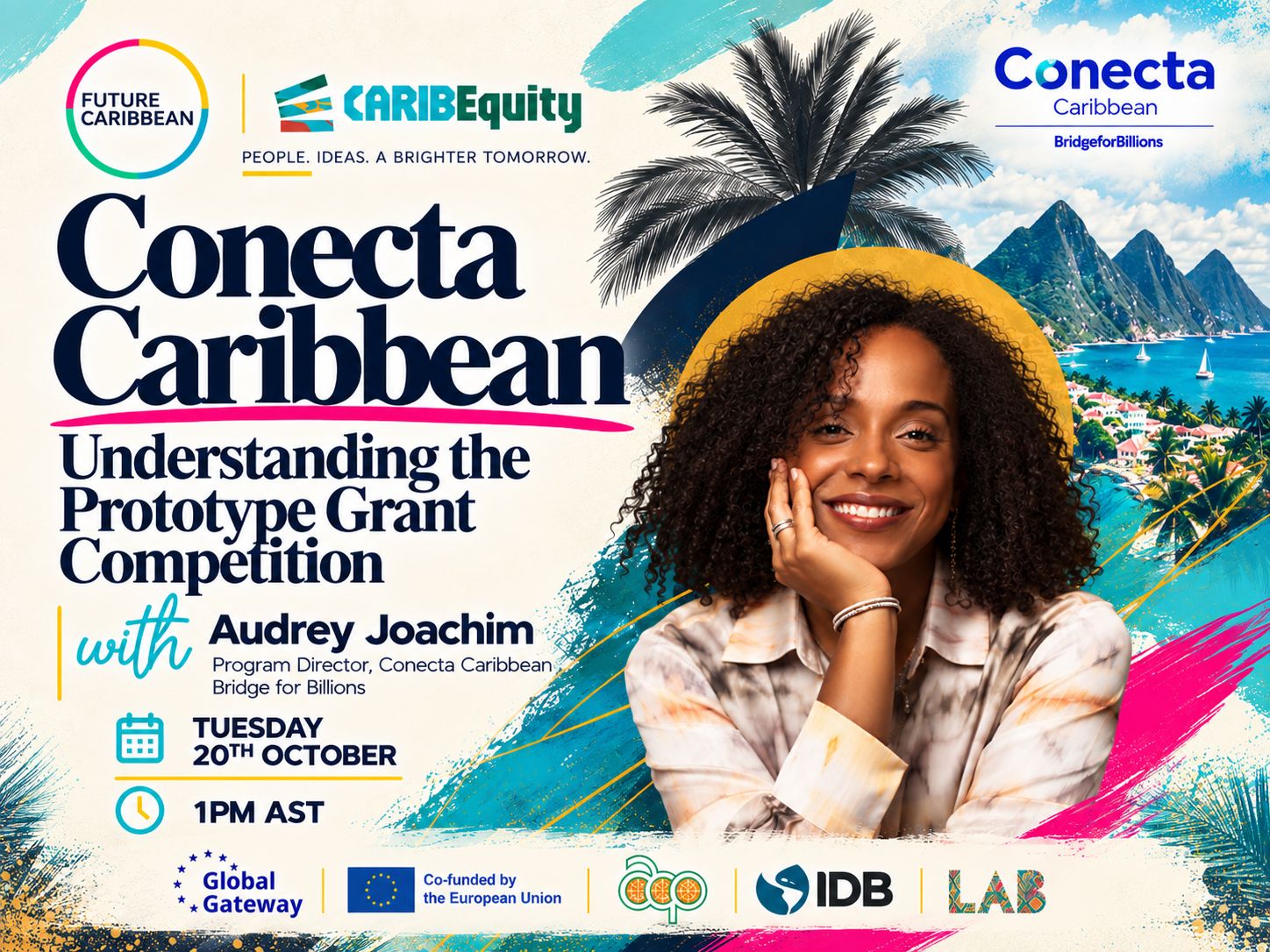
Up to US$40,000 in support for eligible Caribbean founders, with applications closing on 30 October 2026.
The next phase for our Future Caribbean builders is getting their products into real use. That takes access to customers, specialist support and funding that fits the work they need to do. Today, 150 people signed up for our call to learn more about Conecta Caribbean's Prototype Grant Competition and how it could help them take their products forward.
I invited Audrey Joachim, Programme Director of Conecta Caribbean at Bridge for Billions, to walk our community through its Prototype Grant Competition. The opportunity offers up to US$40,000 to help eligible founders develop or test a minimum viable product, with applications closing on Friday, 30 October 2026.
Conecta Caribbean is implemented by Bridge for Billions under CARIBEquity, a facility co-funded by the European Union and IDB Lab. Our session gave builders a chance to understand the funding, ask practical questions and work out whether it matches their next stage.
What the grant can support
Selected founders can receive support for one or two eligible external service providers, alongside six months of coaching from a participating Entrepreneurship Support Organisation, or ESO. The development and coaching period runs from December 2026 to May 2027.
Eligible work includes technical prototyping, software and hardware development, market validation and user testing. An existing prototype can also be considered where the application makes a clear case for further development or testing. Audrey confirmed that the programme does not require an equity stake in the business.
The payment structure matters. Bridge for Billions pays approved service providers directly after their contracted service is completed and validated. Founders do not receive the grant as cash in their accounts, and there are no advance payments or deposits.
A provider that completes its service early does not necessarily have to wait until the end of the full six months, although payment processing can take time. Agree these terms with your provider before applying. Your funding request should match the actual quotations for the work.
Who should look at this opportunity
The competition focuses on founders at the pre-MVP or early-MVP stage whose solutions address challenges affecting underserved or excluded communities.
Audrey explained that eligibility can be established through company registration in one of the 15 CARIBEquity countries or the nationality of a founder or co-founder from one of those countries. This creates a route for eligible Caribbean nationals building from overseas, provided their proposed product demonstrates its intended impact in the region.
The eligible countries are Antigua and Barbuda, The Bahamas, Barbados, Belize, Dominica, the Dominican Republic, Grenada, Guyana, Haiti, Jamaica, Saint Kitts and Nevis, Saint Lucia, Saint Vincent and the Grenadines, Suriname, and Trinidad and Tobago.
Solo founders can apply. An existing business with revenue from another product can also apply, provided the specific MVP being proposed is not yet generating revenue.
The five priority sectors are:
- Agriculture and natural capital
- Essential infrastructure services
- Financial inclusion
- Health
- Education, talent and employment
For our Agentic AI builders, the application needs to explain the problem being solved, who will benefit and what the funded work will allow the team to test or improve.
Start with the right support organisation
Before submitting an application, founders must secure agreement to work with a participating Conecta Caribbean ESO. The programme works with 30 of these organisations across the region.
Your ESO provides coaching, helps you develop an action plan and measurable goals, and supports the validation of completed work. Your external service provider carries out the specific work needed to build or test the prototype. These are separate roles.
Audrey also clarified that founders can work with an ESO in another country. Choose one with the expertise and regional connections relevant to your product, and have that conversation early.
Founders select their own service providers, subject to the programme's eligibility rules. Providers must be genuine third parties, separate from your own team and coaching ESO. Overseas providers may qualify, but their eligibility and willingness to accept the payment terms need to be checked.
The wider question for our builders
During the session, I raised a question that matters for the next phase of Future Caribbean: what support do builders need once they already have something working?
For many Agentic AI teams, the next challenges include compute, cybersecurity, legal structuring, customer acquisition and testing with real users. Those requirements affect whether a promising product becomes a business that can operate and grow.
This grant has a defined role within that journey. It can support eligible prototype development and validation. General legal setup, team salaries, rent and other overheads fall outside its scope. Market validation and user testing may qualify; a broad marketing campaign should not be assumed to qualify.
We also discussed compute and other specialist needs. Teams considering subscriptions, security audits or unusual service arrangements should confirm whether their specific proposal is eligible before building an application around it.
I see a useful opportunity here for founders who need external help to develop or validate their product. Our wider work at Future Caribbean is connecting builders with the resources they need as they move towards deployment and revenue. That requires several kinds of support, with each addressing a different part of the journey.
How to prepare your application
Start with the substantive work before opening the online form:
- Agree to work with a participating ESO. Discuss your product, what you want to achieve and how the organisation can support you.
- Identify one or two eligible providers. Obtain signed letters of engagement and itemised quotations using the programme's templates.
- Complete the pitch deck and budget. Explain your current stage, the proposed work, its feasibility and the impact you intend to create.
- Submit the application with the required documents. Include proof of the relevant nationality or company registration.
Shortlisted applicants will pitch to an independent jury. The assessment considers the team, the problem and proposed solution, the prototype plan, feasibility, budget, impact and alignment with the priority sectors.
Key dates
| Stage | Date |
|---|---|
| Helpdesk closes for applicant questions | 23 October 2026 |
| Applications close | 30 October 2026 |
| Pre-selection | 2–16 November 2026 |
| Pitch days | 23–24 November 2026 |
| Awardees announced | 30 November 2026 |
| Development and coaching | December 2026–May 2027 |
Thank you to Audrey and the Conecta Caribbean team for taking the time to answer our builders' questions. If this opportunity fits what you need next, contact an ESO and your proposed providers now. Those conversations are the foundation of a credible application.
Keep reading
Building the Future on Solana: What Caribbean Developers Need to Know About Blockchain, AI and the Next Generation of Digital Products
Future Caribbean brings the Solana ecosystem closer to Caribbean builders through a session on blockchain infrastructure, AI-powered development, tokenisation and emerging opportunities.

Inside Future Caribbean's 12-Hour Demo Day: The Projects Presented
Across ten tracks, Caribbean innovators explored how AI could respond to real challenges — from energy and transportation to finance, climate resilience, healthcare, and the creative economy.
 CalypsoOctober 12, 2026 · 35 min read