The Ocean Is Not Free: Why the Caribbean's Next Economic Boom May Be Blue
Coral Vita, Ocean Currency Network, Hub Culture, the Caribbean Biodiversity Fund and Permacity on restoration economies, sargassum, and building agentic AI for the blue economy.

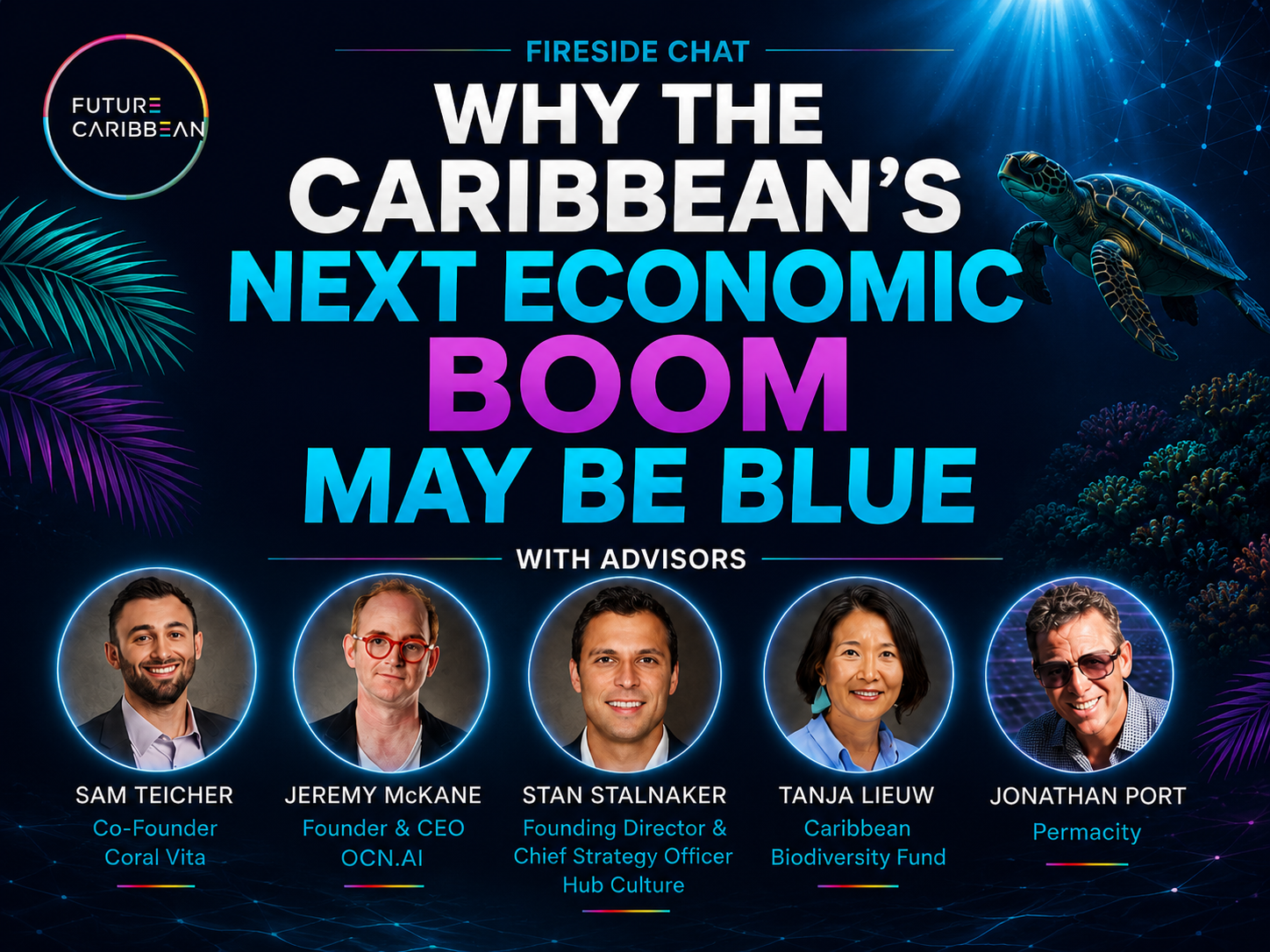
On August 19, a group of ocean entrepreneurs, conservation financiers and technology builders gathered around a deceptively simple question: What could happen if the Caribbean stopped treating its environmental problems only as crises — and started treating them as problems worth building solutions for?
The conversation was part of the Future Caribbean Agentic AI for the Oceans & Blue Economy brainstorming session, bringing together Coral Vita co-founder Sam Teicher, Ocean Currency Network founder Jeremy McKane, Hub Culture's Stan Stalnaker, Caribbean Biodiversity Fund conservation finance manager Tanja Lieuw and Permacity's Jonathan Port.
It was not a conventional technology panel.
The discussion jumped from dying coral reefs to artificial intelligence, from carbon markets to sargassum, from marine-protected areas to the surprisingly difficult question of how to make conservation economically sustainable.
And that was precisely the point.
Future Caribbean framed the session around building "frontier agentic technologies" for the oceans, with the Caribbean as a starting point rather than an afterthought. The idea was to put people who finance nature, restore ecosystems, collect ocean data and build new environmental businesses into the same room with builders who could turn those problems into systems.
What emerged was less a conversation about AI itself than a blueprint for a new kind of blue economy.
From coral restoration to an actual restoration economy
Sam Teicher knows what it looks like when conservation becomes a business.
His company, Coral Vita, grows coral to restore damaged reefs. But the larger idea behind the company is more ambitious than simply planting coral. Teicher described a model in which restoration can be sold as a service, technology can be licensed to others and new financing mechanisms can bring private capital into work that historically depended on grants and philanthropy.
The economic case is hard to separate from the ecological one.
Healthy reefs support fisheries, tourism and coastal protection. Teicher argued that reefs should be understood as infrastructure as much as ecosystems: they protect shorelines, support marine life and help sustain the tourism economies on which many island states depend.
That changes the question from "Who will donate to save the reef?" to "Who benefits economically from the reef being healthy?"
A hotel with a reef in front of it benefits. A government whose coastline is protected benefits. A tourism operator benefits. A fishing community benefits.
Once that connection becomes visible, restoration starts looking less like charity and more like investment.
Teicher described this as part of a broader "restoration economy" — one in which technology, governments, communities and finance can work together to invest in the ecosystems that ultimately sustain human economies.
The money exists. The challenge is directing it differently.
Tanja Lieuw brought a different perspective to the same problem.
The Caribbean Biodiversity Fund manages nearly $200 million in assets and works across 14 Caribbean jurisdictions. Its portfolio touches coral reefs, mangroves, fisheries, agriculture, climate change and the circular economy.
But Lieuw repeatedly returned to something that can easily disappear in conversations about climate finance: people.
Protecting a mangrove simply because mangroves are important is not always enough in communities facing immediate economic pressures. Conservation models also have to consider livelihoods, local awareness, food security and the ability of communities to benefit from what is being protected.
That matters enormously for the Caribbean.
If the next blue economy simply replaces one extractive model with another — only this time using carbon credits, biodiversity credits or AI — it will have missed the point.
The more interesting possibility is to design financial systems in which the people living beside the resource have a reason to help protect it.
Turning the ocean into something we can understand in real time
Stan Stalnaker and Jeremy McKane pushed the conversation toward data.
Hub Culture's Ocean Climate Fund is already focused on areas including ocean data, blue living carbon and the blue circular economy.
McKane's Ocean Currency Network approaches the problem through measurement and verification.
The ocean is extraordinarily difficult to monitor. A vessel can move through a protected area. An anchor can destroy seagrass. Runoff can threaten a kelp bed. A carbon project can claim environmental benefits that are difficult for investors to independently verify.
McKane described systems combining enormous quantities of ocean data in an attempt to understand the ocean as a connected system rather than a collection of isolated projects. OCN, he said, processes roughly two billion data points each week.
That is where agentic AI starts becoming interesting.
Not because the ocean needs a chatbot.
It needs systems capable of noticing what humans cannot constantly watch: anomalies, changing conditions, suspicious activity, ecosystem damage and patterns developing across enormous geographic areas.
AI could become a kind of nervous system for the blue economy — connecting satellites, sensors, researchers, financial markets and governments and helping decide what requires attention.
Then there is sargassum
Few issues illustrate the Caribbean's challenge better.
Massive sargassum blooms now wash onto beaches across the region, damaging tourism, affecting ecosystems and making life miserable for coastal communities.
Stalnaker described the dramatic expansion of sargassum across the Atlantic and the severe effects it is having on Caribbean and Mexican coastlines.
Yet instead of stopping at "How do we get rid of it?", the session moved toward another question: what can we build from it?
Participants discussed startups experimenting with sargassum-based fuels, fertilizers and other products. The opening conversation even raised the possibility of modular processing facilities that could potentially operate at the community or parish level.
That does not make the ecological problem disappear.
But it represents the type of thinking the session was designed to provoke: take an environmental problem, combine science, technology, financing and entrepreneurship, and see whether the cost can become an economic input.
Breaking the silos
Perhaps the most important intervention came from Jonathan Port.
Port described work using carbon markets to generate roughly $1.5 million for restoration and then asked the question hanging over almost every nature project: How do you make this financially sustainable?
Grant-funded projects can do important work, but they often have to return year after year asking for another grant.
Port argued for systems capable of helping conservation work become self-sustaining — and warned against breaking nature into separate financial categories such as carbon, biodiversity, coral, seagrass and kelp when the ecosystem itself does not recognize those boundaries.
That may also be the strongest argument for agentic technology.
The ocean does not operate in silos.
Coral affects fish. Mangroves affect coastlines. Seagrass stores carbon. Tourism depends on biodiversity. Shipping affects habitats. Agricultural runoff hundreds of miles away can change what happens offshore.
Yet the organizations trying to solve these problems often operate separately.
AI may be most powerful not when it replaces one of those organizations, but when it helps them see the same system.
The Caribbean as a place to build
There is something especially compelling about locating this experiment in the Caribbean.
The region is already on the front line of climate change, marine degradation, coral loss and coastal vulnerability. But it also possesses some of the ecosystems that will matter most in a climate-constrained world.
That makes the Caribbean more than a place that needs solutions.
It can be a place that creates them.
Coral farms that can be exported globally. AI systems that monitor marine ecosystems. New ways to finance protected areas. Community-owned sargassum businesses. Ocean datasets capable of making environmental value measurable. Financial structures that allow conservation projects to survive without waiting for the next grant.
None of these ideas alone will "save the ocean."
That was almost the point of bringing everyone together.
There is no single ocean solution because there is no single ocean problem.
The opportunity is to connect the people restoring reefs with the people financing conservation, the people collecting data, the people designing markets and the builders creating the next generation of intelligent systems.
And if that works, the most important product of agentic AI for the oceans may not be an AI agent at all.
It may be an entirely new way of seeing the Caribbean's natural assets: not as scenery to admire, resources to extract or problems to manage — but as the foundation of an economy worth building.
Inside Future Caribbean's 12-Hour Demo Day: The Projects Presented
Across ten tracks, Caribbean innovators explored how AI could respond to real challenges — from energy and transportation to finance, climate resilience, healthcare, and the creative economy.
A Glimpse Into Future Caribbean's Demo Weekend
A weekend celebrating Caribbean innovation, AI-powered problem-solving, and the people building solutions for the region's future.