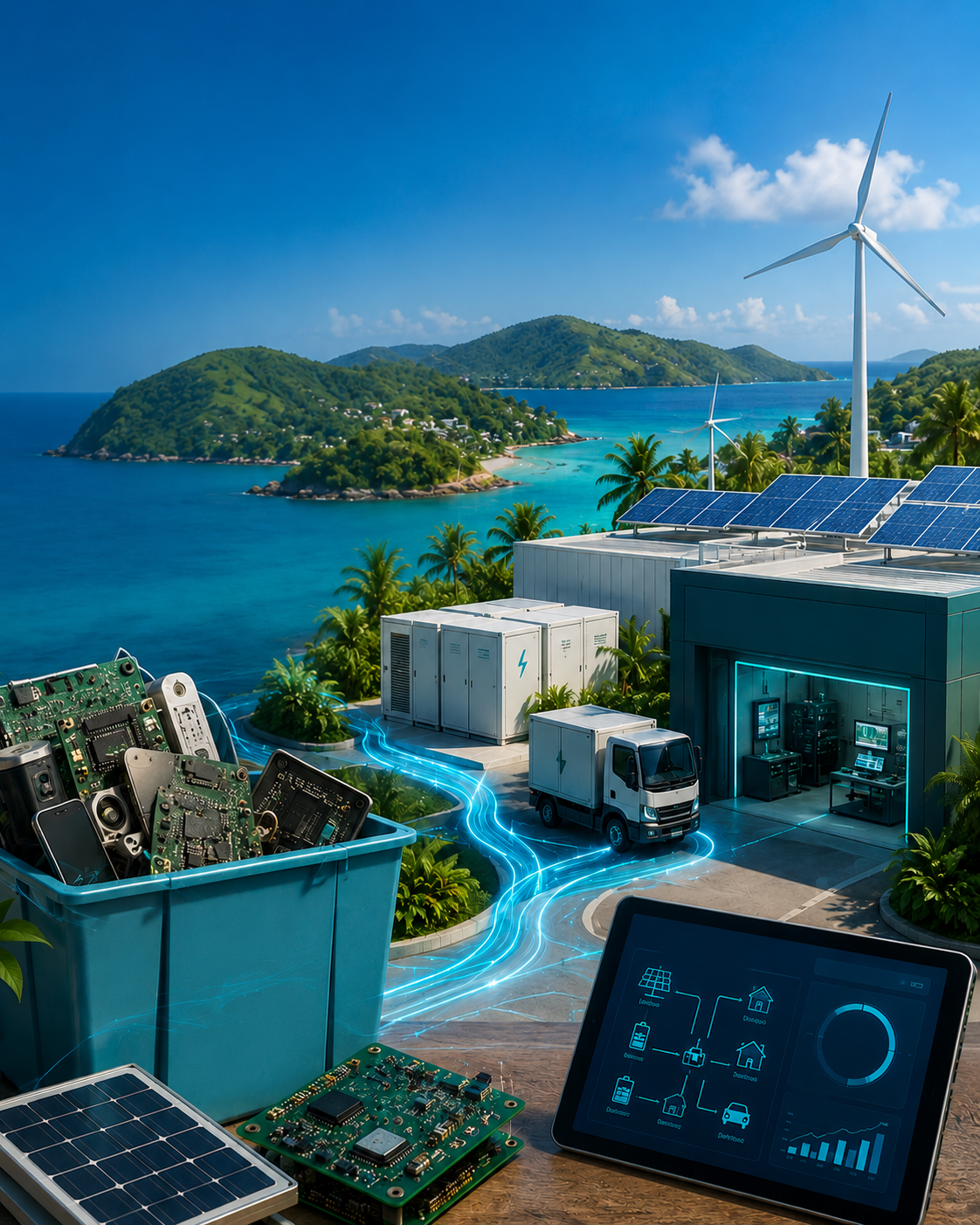
The Electron Economy
Industrializing Electron Management for Small Island Economies.
Join the waitlist →Energy Management Systems, Electron Coordination, Battery Storage, Grid Intelligence, Compute Efficiency, and Island Resilience.
Every modern economy runs on electrons.
Every home, business, factory, vehicle, data center, water system, telecommunications network, and AI platform depends on access to affordable, reliable energy.
For island nations, energy is one of the greatest levers for economic expansion, industrial development, climate resilience, and national competitiveness.
Future Caribbean challenges builders to create always-on Agentic AI systems that manage electrons as intelligently as modern financial systems manage capital.
Not simply generating energy. Not simply reducing costs. But creating new economic coordination systems around the production, storage, exchange, forecasting, allocation, and optimization of energy resources.
The future belongs to countries that can coordinate electrons at machine speed.
This revolution industrializes intelligence.
The First Industrial Revolution industrialized muscle.
The Second industrialized manufacturing.
The Third industrialized information.
The next generation of economies will be powered by systems capable of continuously managing, across millions of decisions every day:
- Electron production
- Electron storage
- Electron allocation
- Electron pricing
- Electron exchange
- Battery capacity
- Compute consumption
- Grid resilience
- Resource optimization
This track focuses on building those systems.
Coordination layers for the next generation of energy economies.
Battery Exchange Economies
Peer-to-peer battery marketplaces, capacity exchanges, dynamic storage leasing, community energy banks, AI-managed battery cooperatives, and virtual power plants that turn storage into a productive economic asset.
Electron Markets
Local energy exchanges that match surplus producers with consumers, coordinate distributed generation, enable peer-to-peer transactions, and settle electron usage in real time — moving electrons as efficiently as money.
Agentic AI Energy Managers
Autonomous agents for households, hotels, factories, farms, clinics, and public facilities that continuously manage consumption, storage, cost, reliability, carbon, peak demand, and grid interaction without human intervention.
Distributed Solar Intelligence
Coordination systems for rooftop fleets, commercial installations, community solar, forecasting, real-time generation balancing, and solar-to-storage orchestration. The opportunity is coordination, not just generation.
Wind & Renewable Forecasting
Predictive systems using trade winds, solar irradiance, cloud cover, and island microclimates to forecast generation, manage ramp rates, reduce curtailment, and intelligently price and dispatch energy.
Grid Intelligence & Island Resilience
Load balancing, frequency regulation, outage prediction, hurricane response, fuel disruption response, microgrid islanding and reconnection, and resilient planning for critical facilities.
Ocean & Cooling Intelligence
Seawater district cooling, thermal energy optimization, coastal energy infrastructure, and cooling intelligence for hotels, data centers, hospitals, airports, and public infrastructure. Geography as an energy advantage.
Tourism Energy Optimization
Coordinated energy systems across hotels, villas, resorts, airports, cruise terminals, EV charging networks, backup power, and cooling — driven by occupancy, weather, and booking data.
Bytes, Compute & Energy Intelligence
National compute utilization, AI workload optimization, data center orchestration, carbon-aware compute scheduling, and measurement of how efficiently a nation converts electrons into economic output.
National Energy Operating Systems
AI-native platforms for governments, utilities, and operators to coordinate production, storage, grid investment, demand forecasting, resilience planning, and market design. Less dashboard, more autonomous operating system.
Biological Energy Systems
Optimization across agricultural energy, water-energy relationships, controlled environment agriculture, biological carbon systems, and nature-integrated infrastructure — economic intelligence that strengthens environmental intelligence.
Fifteen concrete systems worth building.
- An AI system that lets households and businesses trade excess battery capacity.
- A national energy coordination agent that forecasts demand and allocates storage assets.
- An autonomous hotel energy manager that reduces electricity costs while protecting guest experience.
- A platform that measures how effectively a country converts electrons into economic productivity.
- An AI-powered virtual power plant coordinating thousands of distributed energy assets.
- A peer-to-peer marketplace for electrons generated from distributed solar systems.
- An AI coordination system for battery fleets, EV charging networks, and distributed storage.
- An energy-aware compute system that schedules AI workloads based on cost, renewables, and grid conditions.
- A national energy resilience agent for hurricanes, outages, fuel disruption, and emergency response.
- An energy operating system for tourism assets — hotels, villas, EV fleets, cooling, and backup power.
- A microgrid coordination system for communities, campuses, industrial estates, and critical facilities.
- An AI platform that forecasts renewable generation and automatically coordinates storage, pricing, and demand response.
- A system helping governments and utilities prioritize energy infrastructure investments by cost, resilience, and economic impact.
- A platform turning distributed solar, batteries, EVs, and backup generators into coordinated virtual energy infrastructure.
- An AI system that helps small businesses lower electricity costs through automated load shifting, storage optimization, and equipment management.
Builders working across the energy and intelligence stack.
Working systems with a path to deployment.
- A working AI system, agent, platform, prototype, or simulation.
- A clear energy coordination use case.
- Real-world relevance to island economies.
- Ability to reduce cost, improve reliability, increase resilience, or unlock new economic value.
- A practical deployment pathway with households, businesses, hotels, utilities, governments, or infrastructure operators.
- Potential to scale across the Caribbean and other distributed markets globally.
The future of energy is not only generation. The future of energy is coordination.
The Caribbean is uniquely positioned to become a global testbed for intelligent energy systems — small enough to deploy quickly, yet sophisticated enough to demonstrate solutions that scale worldwide.
The winners will not simply build better solar projects. They will build the coordination layer for the next generation of energy economies.