From Carnival to Claude: The Caribbean’s Next Wave of Builders
Justin Elliott joined Future Caribbean to talk about Agentic AI. His most compelling message was about knowing a problem well enough to build something people need.

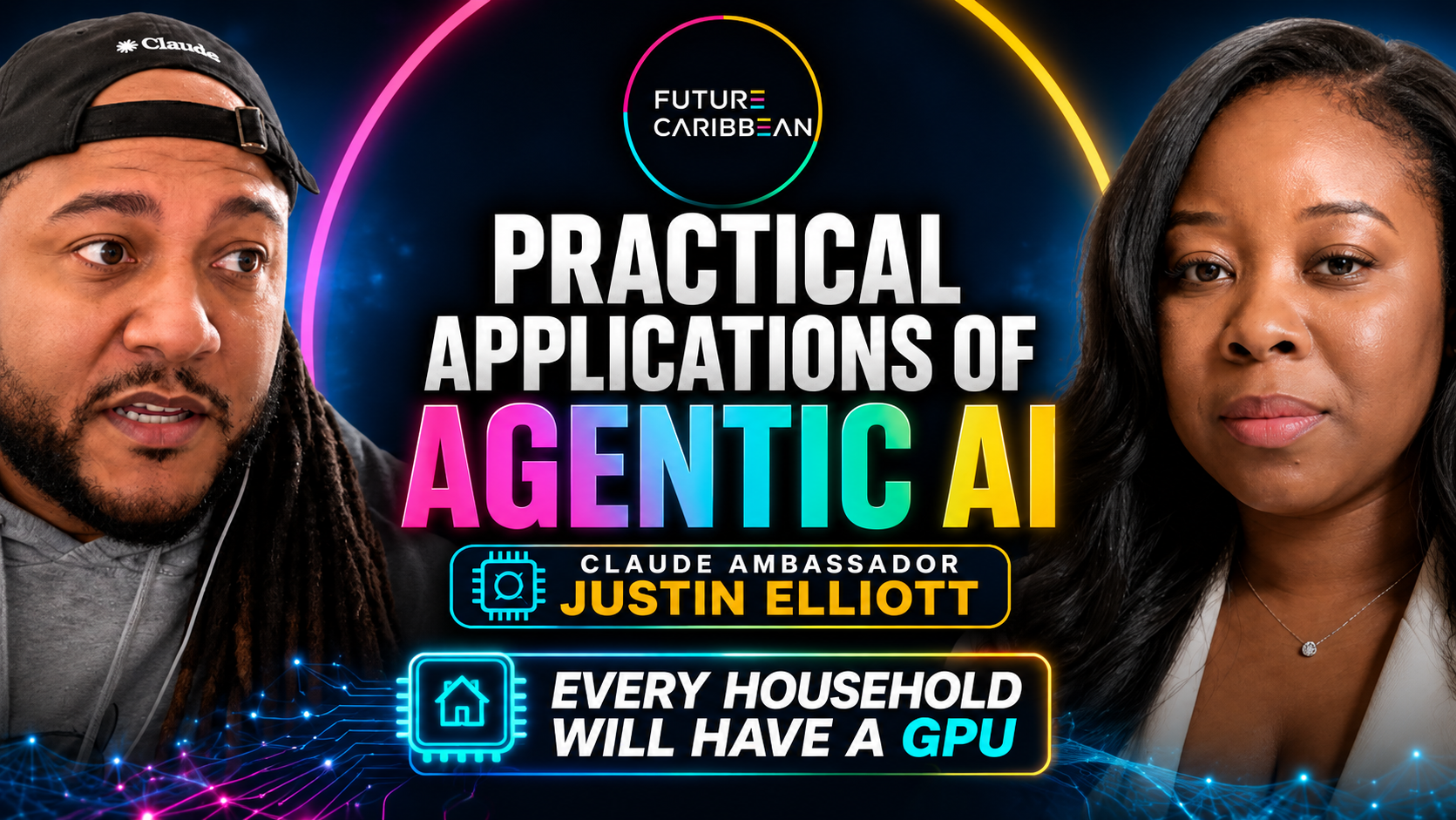
Justin Elliott joined Future Caribbean to talk about Agentic AI. His most compelling message was about something technology cannot hand you: knowing a problem well enough to build something people need.
In 2020, Justin Elliott arrived in Trinidad with the kind of momentum artists spend years chasing.
On the drive from the airport, he recalls hearing one of his songs playing on three radio stations at the same time. Known as CoolBlaze, he had spent a decade building a career as a touring DJ, music producer and event producer. His bookings stretched 18 months ahead, with appearances planned across Africa, Dubai, Europe and Asia.
Then COVID hit.
A career built around bringing people together suddenly faced a world in which people could no longer gather. Elliott found himself reconsidering what the next five, ten or twenty years of his life should look like.
His eventual move into technology was not a leap into entirely unfamiliar territory. He had studied engineering, built robots, worked with computer-aided design and developed websites. But when the Worth App co-founder and Claude Ambassador joined Future Caribbean, the most interesting part of his story was not the change of profession. It was how much of his previous experience turned out to matter.
A sneaker shop helped him see it.
Five pairs of sneakers. Five different businesses on the balance sheet.
Elliott initially considered building a platform connecting artists, producers, songwriters and musicians. It would draw directly on the industry he knew.
Then a promoter introduced him to a cousin who owned a sneaker shop in Miami’s Wynwood neighbourhood. The cousin, Dream, was having problems with his website. Could Elliott take a look?
What followed was a two-hour conversation about a business that its software did not adequately understand.
A shop could acquire five pairs of the same sneaker: identical colour, size and release date. But each pair might have a different purchase price. One might be unworn. Another lightly used. Each individual item carried its own condition, cost and commercial history.
Tracking the product category was not enough. The business needed to understand each item.
Elliott recognised the problem immediately. Before his full-time entertainment career, he had managed e-commerce and digital marketing for a luxury jewellery business. Watches, jewellery and sneakers were different products, but the operational frustration sounded remarkably familiar.
A decade had passed, and someone was still wrestling with a problem he remembered from his own working life.
That recognition helped lead him to build Worth. He saw a substantial problem and felt unusually well positioned to solve it.
For anyone looking for an Agentic AI business idea, there is something worth pausing over here: the problem you have become accustomed to working around may be the one another person is still desperately trying to solve.
Your experience may be more valuable than the trend
Throughout the conversation, Elliott returned to people building from lived experience.
He described a friend, Fritz, who wanted a better way to organise his hockey group. Getting players to confirm their attendance and coordinating schedules had become a headache. After attending a workshop, Fritz built an app using Claude.
According to Elliott, it progressed from something his own group used to something used by the league and arena, with other leagues expressing interest.
The starting point was getting people to show up for hockey. The wider opportunity emerged from solving that problem.
Elliott was considerably less enthusiastic about people abandoning their existing knowledge to chase whatever AI business model was fashionable.
His example was a nurse with twenty years of experience deciding to start an AI marketing agency. Why compete in an unfamiliar field against people who understand marketing deeply and have access to the same tools?
And that existing knowledge need not come exclusively from a profession. Perhaps the nurse also grew up raising horses and understands their feeding, breeding, exercise and care. An underserved business in that world might offer a more meaningful starting point.
His advice was to take that accumulated experience seriously. It can tell you what is missing, what a useful solution should do and when an apparently impressive answer is wrong.
Would anyone come looking for you if your product disappeared?
Elliott has a deliberately dramatic test for whether a product matters.
Take it away. Would somebody come banging on your front door?
He uses that image to describe the kind of usefulness founders should be working towards: a product that becomes important enough to someone’s life or business that losing it creates a real problem. In his telling, that dependence is a powerful signal of product–market fit.
It is a different standard from producing an impressive demonstration.
A demo can show possibility. Elliott’s test asks whether someone has found a reason to keep using what you have built.
He was equally direct about the promise that anyone can create “the next billion-dollar app in 15 minutes with one prompt.” He rejected it. People who have never built software, he noted, can encounter problems they did not even know existed.
The opportunity is being able to start: make a first version, demonstrate the idea, then build and iterate. The rest of the work has not disappeared.
His suggested starting point for useful Agentic AI was practical: look at the repeatable work consuming people’s time.
He described an Impact Lab project focused on procurement for city parks. The existing process, he said, occupied roughly twenty hours of staff time each week at one park. His argument was about the cumulative value of addressing that kind of overlooked work—and what people could do with the time recovered.
Not every valuable application needs to become a billion-dollar company to deserve being built.
Before adding agents, work out the jobs
When the conversation turned to multi-agent systems, Elliott reached for an organisational analogy.
He thinks about employees.
What departments would the business need? What should each role produce? Which specialist skills and tools would be necessary?
A marketing role might need to be broken down into copywriting and social media. Social media might require different approaches for different platforms. He described mapping an executive layer and then identifying the specialists needed beneath it.
The emphasis was on understanding the work before deciding how to distribute it.
His approach then follows a sequence: context, perspective, workflow and iteration.
Context means assembling the information needed for the task. Perspective establishes how the agent should approach it. Workflow defines the expected relationship between what goes in and what comes out. Iteration means reviewing the result and improving it.
One detail stood out against the fifteen-minute-app narrative: Elliott said he spent about two weeks assembling the context library for a marketing agent, drawing on approximately fifty books and relevant case studies.
That was preparation before expecting the system to perform consistently.
He also described using different models for different kinds of work rather than assuming a single provider would be his best choice for every task. Whatever the combination, he emphasised being able to inspect outputs, check that the system was doing what it should and refine it.
The useful question running through his approach was concrete: what does good work look like, and have you given the system enough information to recognise it?
Building for the Caribbean means understanding how people already work
The discussion became particularly relevant to the Caribbean when it turned to fragmented information.
The question put to Elliott described an environment where important knowledge might be spread across PDFs, WhatsApp messages, spreadsheets and people’s heads, with limited connections between the systems holding it.
He recognised the situation from his own business. Worth, he explained, was also being built around fragmented data, with products moving across numerous marketplaces.
For Caribbean builders, he saw an opportunity in making industry-specific information easier to find and query: bringing together relevant documents, requirements and records that were otherwise difficult to use collectively.
But he was explicit about the need to check the work.
A model might lack current information or know little about a particular parish or market. A builder still needs to know where reliable information lives.
He recalled a marine scientist recognising that an AI system had selected the wrong database for a project. The scientist knew a more appropriate source. That judgment came from expertise, not from accepting the first answer returned.
Local knowledge matters twice: when deciding what to build, and when judging whether it works.
Elliott also saw promise in the interface itself. He pointed to businesses using WhatsApp voice notes and photographs to initiate AI-supported workflows, allowing people to interact through habits they already understood.
As he put it, technology was beginning to meet people where they were, rather than always requiring people to meet technology where it was.
He connected that possibility to collaboration across islands: comparing how similar problems are handled, sharing resources and reusing useful agent skills in areas such as logistics and procurement. Future Caribbean was one of the communities he identified as a place for that exchange.
A harder question for anyone building an AI business
During the audience questions, someone asked about creating an AI-powered career guidance service for young people.
Elliott responded with a test that could apply to many proposed products: could a person open a general-purpose AI assistant and get much the same result?
His point was to examine what the business offered beyond the model’s underlying capabilities.
In his example, a career platform could become more compelling through relationships with employers, access to scholarships and a genuine pathway into opportunities. The guidance could be the entry point, but the surrounding relationships and services would matter.
The distinction was between generating advice and building something that could help a person act on it.
That question deserves to stay with founders long after the demonstration is over:
What can someone get through your product that they cannot easily get without you?
Plans for Claude Caribbean
Towards the end of the session, Elliott shared something he said he had not yet publicly rolled out: plans for an initiative called Claude Caribbean.
He described seeking island-based ambassadors to convene workshops, share resources and help people learn and build together. His intended audience extended beyond engineers to small-business owners, parents and others curious about applying the tools in daily life.
He also outlined plans for a workshop in Jamaica and a Claude Impact Lab in Jamaica in December. These were forthcoming plans described during the conversation, rather than a fully confirmed event calendar.
For Elliott, the importance of community was personal. Earlier, he had spoken about the Caribbean Student Association and the relationships formed among people who found familiarity with one another while living away from home. Later, he described the ambassador network as another community through which people exchanged knowledge, resources and practical help.
His concern was that the Caribbean could be left further behind while others learned to use the technology.
His response was to bring more people into the work.
“Somebody’s going to take advantage of it, so it might as well be us.”
Elliott spent a decade bringing people together around music. He is now working to bring them together around what they can build.
And the starting point he kept returning to was refreshingly specific: a problem you understand, people who share it, and the willingness to keep working beyond the first version.
Patch Tuesday, Exploit Wednesday: How AI Just Closed the Gap Between a Hack and a Fix
Sigma Prime co-founder Mehdi Zerouali tells Caribbean builders the real risk of vibe-coded software is not bad code — it is what nobody thought to ask an AI to protect.
AI Can Generate the Video. It Can't Decide What People Should Feel.
Inside Future Caribbean's Cinematic AI Video & Visual Storytelling Workshop with Dallas and Sharon of Mercury Tech — creative direction, emotional storytelling and why founders should stop romanticizing their product.