The Caribbean's Healthcare Reset: What Happens When Agentic AI Meets a Broken System?
Inside Future Caribbean's Agentic AI for Healthcare session — medication safety, FHIR interoperability across borders, voice-driven clinical documentation, and why adoption, not technology, is the hardest problem.

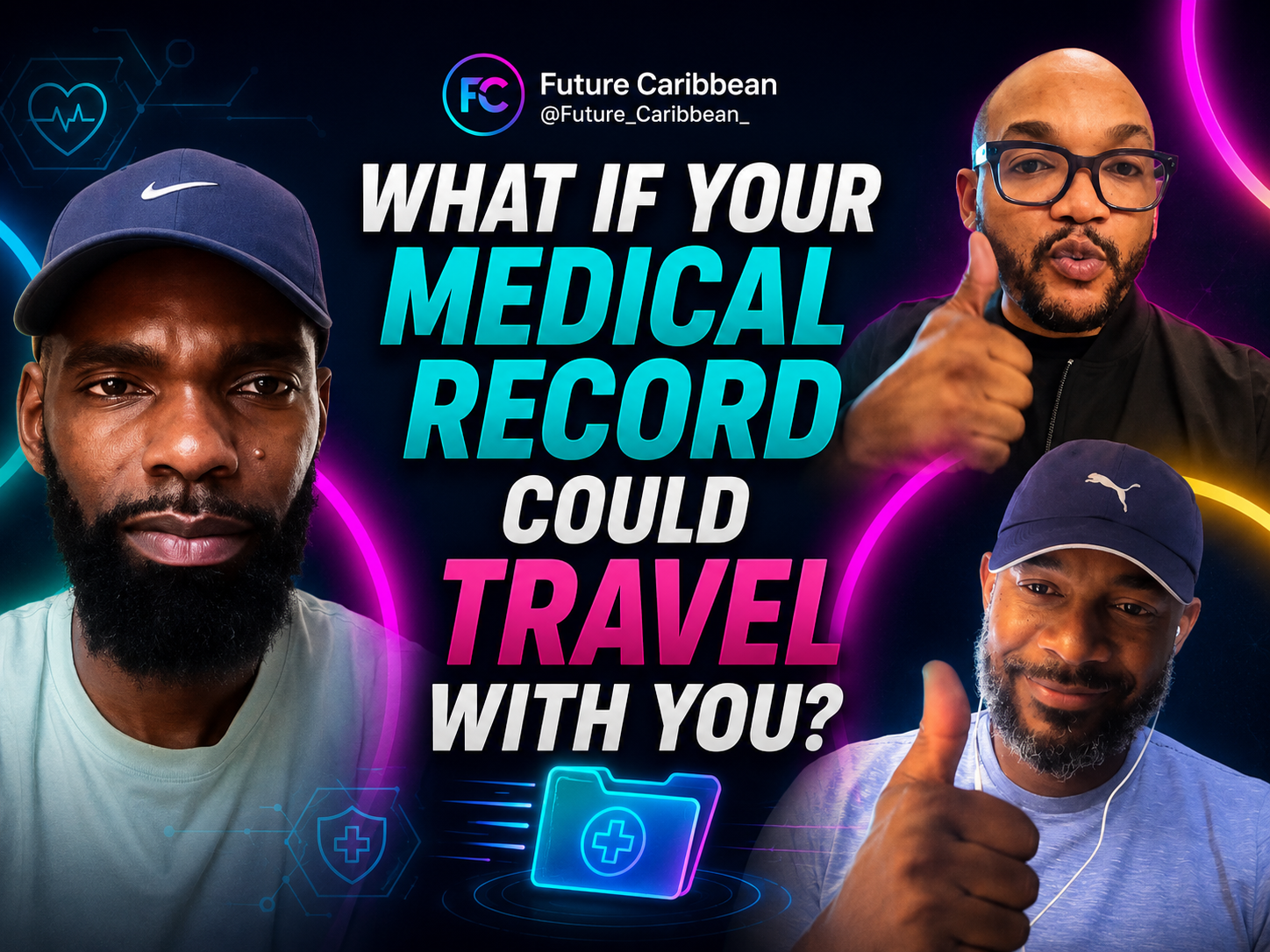
Inside Future Caribbean's Agentic AI for Healthcare brainstorming session, builders and advisors explored a bigger question: what if the Caribbean could build the healthcare infrastructure of tomorrow — without simply copying yesterday's systems?
Healthcare across the Caribbean is often defined by fragmentation.
A patient may see one doctor, visit another island for specialist care, fill a prescription at a different pharmacy and enter a hospital system that has no visibility into what happened before. Medical records can remain trapped within individual institutions, while in some settings, paper files are still part of everyday clinical workflows.
But during a recent Future Caribbean Agentic AI for Healthcare Brainstorming Session, hosted by Lily Dash, the conversation made one thing clear: the region is not short on ideas — or technical talent.
The session brought together healthcare builders, technology professionals and advisors to explore the problems facing Caribbean healthcare, the solutions already being developed, and how those solutions can be refined to create meaningful impact.
The discussion quickly moved beyond the question of what AI can do. The bigger question became: how can Agentic AI actually work within Caribbean healthcare systems, for Caribbean patients and the people delivering their care?
From fragmentation to a connected Caribbean health system
One of the strongest demonstrations came from Matthew Kisnam, who presented Hellenist Care, a comprehensive Health Information System covering major clinical areas including triage, A&E, outpatient and inpatient care, theatre, pediatrics, laboratory and radiology.
A key focus of his work is medication safety.
In many Caribbean healthcare environments, a patient's complete medication history may not be immediately available when they move between providers — or even between countries. Kisnam highlighted the difficulty of maintaining a consistent record of medications when patients travel between islands for treatment.
Hellenist Care's prescription review queue introduces an agentic layer that can review prescriptions and flag potentially dangerous medication conflicts. Importantly, the system does not replace the physician's judgment. Instead, it escalates potential risks so that the attending physician can make the final decision, including weighing the potential benefits of a medication against its risks.
That distinction became one of the session's most important themes: agentic AI should support clinical judgment — not replace it.
What if your medical record could travel with you?
The conversation then moved beyond individual hospitals and into a distinctly Caribbean challenge: what happens when patients cross borders?
Kisnam described a broader vision in which healthcare information could move securely with patients, subject to appropriate consent. The concept is particularly relevant in a region where patients routinely travel between countries for specialist care, procedures or treatment. Instead of arriving at a new facility with incomplete paperwork — or no accessible medical history — the patient could authorize the receiving provider to access the information they need.
Interoperability is central to making that possible. The discussion explored FHIR as a way for different health technology systems to communicate, allowing one platform to request information from another rather than forcing every healthcare provider to use the same software.
The potential is significant: a patient's health information could remain connected whether they receive care in Saint Lucia, Jamaica, Barbados, Trinidad or another Caribbean country.
But the conversation also emphasized that interoperability cannot ignore local laws. Consent requirements can vary between jurisdictions. As discussed during the session, a system operating in one country may allow physician-to-physician sharing under certain circumstances, while another jurisdiction may require the patient's explicit permission before their information can be accessed.
A truly regional system therefore has to understand not only technology, but the legal realities of each island.
Making doctors' lives easier — not giving them more software
Martin Hanna of MedVoice AI approached the challenge from another angle: clinical documentation.
The platform demonstrated how voice-to-text and multiple AI agents could help transform a doctor's spoken notes into structured clinical documentation. The workflow can take dictated information, provide context from previous encounters, structure it into a standard SOAP note and then run additional compliance checks for issues such as missing information or documentation gaps.
The system also incorporates agent transparency, allowing users to see which agents ran, how long they took, what they did and what the outcome was. An audit trail records activity within the system — an especially important consideration in healthcare environments.
The underlying principle is straightforward: technology should reduce the administrative burden on healthcare workers, not create another layer of work.
That point was reinforced throughout the discussion. A sophisticated healthcare platform has little value if doctors and nurses end up spending more time managing the technology than caring for patients.
The technology isn't the hardest part
Rohan Smith, a software developer from Jamaica working on Unamed, offered one of the most revealing observations of the session.
After seeing multiple builders developing solutions around similar healthcare challenges, he noted that software may no longer be the biggest barrier to innovation. The harder problem is getting these tools into the hands of the people they are intended to serve.
Rohan described encountering medical records still being maintained on paper in local healthcare settings. His approach focuses on creating accessible systems that can work for smaller medical offices and environments that may not yet have sophisticated digital infrastructure.
That perspective highlights an important reality for Caribbean innovation: the best solution is not necessarily the most technologically advanced one. It is the one people can actually adopt.
Build the foundation before building the future
The need for adoption became even clearer through Jessy's contribution to the discussion.
Drawing on experience working with major healthcare networks and electronic medical record systems, Jessy emphasized the complexity involved in digitizing and connecting healthcare infrastructure. She described the challenges of integrating fragmented systems, protecting data and ensuring that information remains accurate throughout a large-scale rollout. One previous interconnected healthcare implementation she referenced took approximately two years to roll out.
For Caribbean builders, that experience offers an important lesson. Digitizing healthcare is not simply about creating a better interface or adding AI. It requires infrastructure, cybersecurity, data governance, interoperability, training and user buy-in.
Jessy also stressed the responsibility that comes with handling sensitive patient information. Developers need to design systems with the assumption that patients' data must be protected, while also keeping the ultimate goal — better patient outcomes — at the centre of the work.
Better outcomes must remain the north star
Throughout the discussion, Al Pierre reinforced a principle that became central to the conversation: the goal of healthcare innovation is ultimately better patient outcomes.
That sounds simple, but it provides an important test for every new AI solution. Is it making care safer? Is it reducing administrative burden? Is it helping clinicians make better-informed decisions? Is it improving the patient's experience?
If the answer to those questions is no, then technological sophistication alone does not equal progress.
The discussion repeatedly returned to the importance of AI functioning as assisted intelligence — supporting clinicians with information, automation and alerts while leaving consequential healthcare decisions in human hands.
The Caribbean needs digital foundations
Later in the session, Alistair, an IT professional working with thousands of doctors at a major New York medical institution, brought an international perspective to the discussion.
With experience working with complex EMR and EHR environments, including Epic, Alistair argued that the Caribbean needs to think beyond individual applications. The region needs stronger digital foundations that allow different healthcare systems to operate within a shared framework of security, compliance and interoperability.
That includes carefully defining who can access what information. A receptionist, nurse, physician or other member of a patient's care team may all need access to a patient's information — but they may not need access to the same information.
As healthcare becomes increasingly digital, cybersecurity and resilience become just as important as functionality. More connected systems also create more potential points of vulnerability, making security an essential part of the infrastructure rather than an afterthought.
Interoperability isn't optional
Perhaps the strongest point of consensus from the session was that Caribbean healthcare cannot continue operating as a collection of isolated digital islands. The systems have to be able to speak to one another.
The discussion referenced the Pan American Health Organization's IS4H framework and its regional push toward interoperable digital health systems. The broader direction aligns closely with what the builders in the room were already working toward: creating systems capable of securely exchanging clinical information across institutions and borders.
This is particularly important for the Caribbean. People move between islands for healthcare. Specialists work across multiple jurisdictions. Patients seek treatment outside their home country. Yet the systems holding their medical information often remain disconnected.
Interoperability could transform that experience. Instead of healthcare data stopping at the border, the patient's care journey could continue with it.
The hardest problem isn't AI. It's adoption.
Perhaps the biggest takeaway from the session was also the simplest: the Caribbean does not need more technology in isolation. It needs technology that people will actually use.
That means designing for doctors who may still rely on paper. It means creating tools that reduce workloads rather than increase them. It means accounting for Caribbean accents, local workflows and the realities of smaller healthcare facilities. It means building around different regulatory environments and consent requirements. And it means involving the people who actually use healthcare systems in the process of building them.
The technical capability is increasingly there. The challenge now is implementation.
From brainstorming to action
For Future Caribbean, the session was never intended to be just another conversation about what could happen. It was about moving builders closer to the people, institutions and expertise that can help turn ideas into real solutions.
Lily Dash encouraged builders to take advantage of the healthcare advisors available through the Future Caribbean platform, including advisors with experience across healthcare in the Caribbean, Africa and Canada. These conversations give builders an opportunity to pressure-test their ideas, understand real-world requirements and identify potential pathways for collaboration.
The bigger opportunity is regional collaboration. Imagine a Caribbean where:
- A patient's medical history can follow them from island to island.
- Doctors can securely access relevant records with patient consent.
- AI can flag potentially dangerous medication conflicts before they become incidents.
- Clinical documentation can be automated without removing the clinician from the process.
- Healthcare workers spend less time on administration and more time with patients.
- Different healthcare platforms can communicate without requiring every country to adopt the same system.
- Patient data is protected by design.
- Caribbean builders are creating technology specifically for Caribbean realities.
That future does not require the region to wait for someone else to build it.
The builders are already here. The ideas are already here. The expertise is already here.
The next step is turning those ideas into infrastructure — and turning infrastructure into impact.
Because the question is no longer whether Agentic AI can transform Caribbean healthcare. The question is whether we can come together to build the connected, patient-centred healthcare system the Caribbean deserves.
Inside Future Caribbean's 12-Hour Demo Day: The Projects Presented
Across ten tracks, Caribbean innovators explored how AI could respond to real challenges — from energy and transportation to finance, climate resilience, healthcare, and the creative economy.
A Glimpse Into Future Caribbean's Demo Weekend
A weekend celebrating Caribbean innovation, AI-powered problem-solving, and the people building solutions for the region's future.