David Mullings on Building, Funding and Scaling the Future Caribbean
Blue Mahoe Capital's David Mullings on trading scarcity for abundance, climate and housing opportunities, the region's data gap, founder-market fit, and building investment bridges between global capital and Caribbean assets.

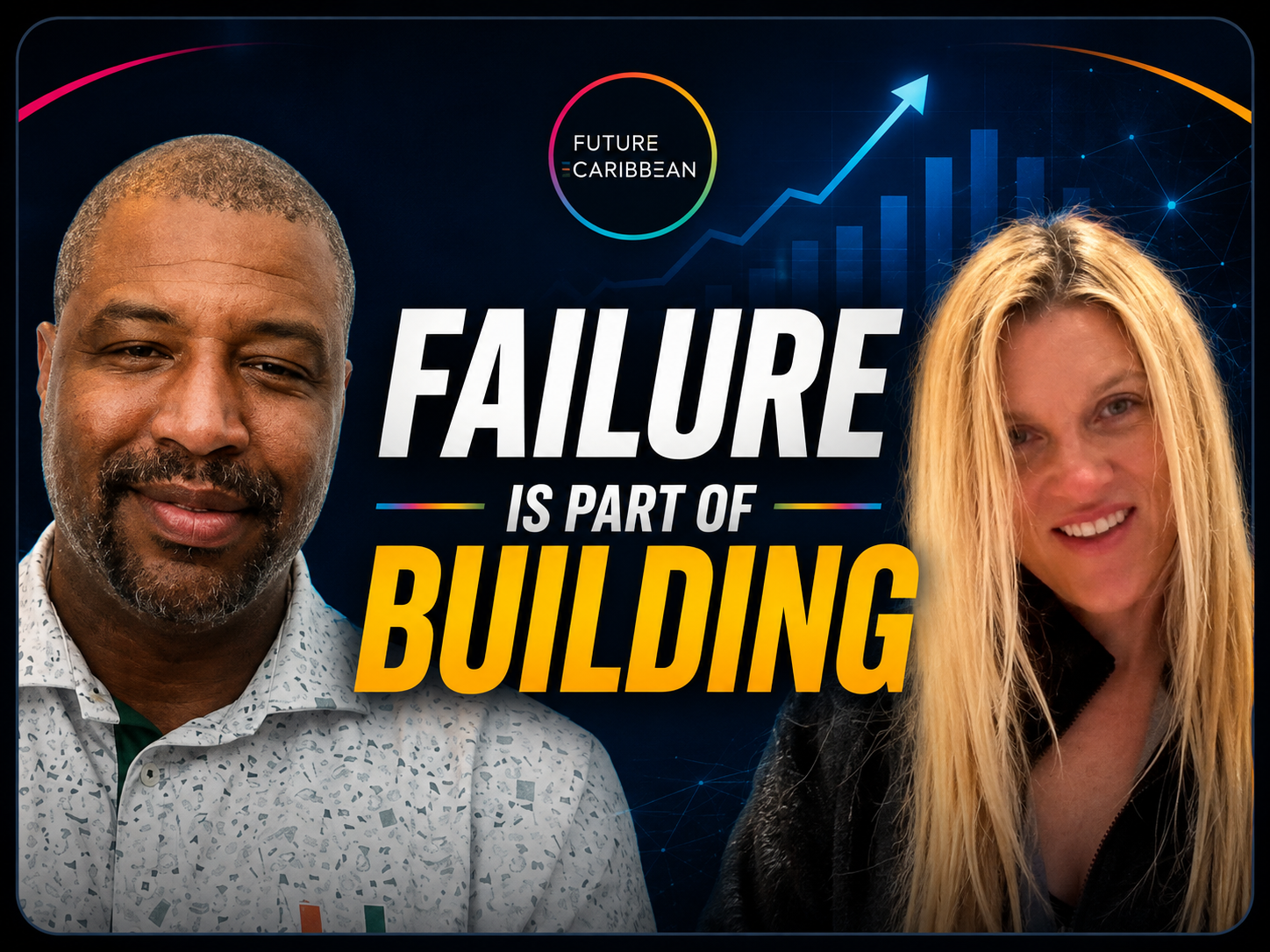
Future Caribbean hosted a Finance Track advisory session with David Mullings of Blue Mahoe Capital to explore what it will take to build a stronger investment and innovation ecosystem across the Caribbean.
Hosted by Lily Dash, the conversation went beyond traditional startup finance. David drew on his experience across entrepreneurship, private equity, public markets, Caribbean investment, technology and real estate to discuss some of the region's most important opportunities: climate resilience, water, housing, energy, payments, transportation, data infrastructure and access to risk capital.
At the center of the conversation was a challenge to Caribbean builders and investors alike: move away from thinking of the region as a collection of small, disconnected markets and start treating it as a connected ecosystem capable of building and financing globally relevant companies.
From scarcity to abundance
One of the strongest themes of the session was mindset.
David argued that Caribbean economies have historically been shaped around scarce resources and finite markets. Whether the commodity was sugar, coffee or another traditional export, businesses often learned to think in terms of protecting a limited piece of an existing opportunity.
He encouraged entrepreneurs to replace that scarcity mindset with an abundance mindset. Instead of assuming another entrepreneur's success takes something away from you, founders can look for ways to expand markets, move up value chains, collaborate and create entirely new sources of value.
A small amount of water has to be protected. A river can support far more people.
Climate resilience is not optional
When Lily asked where builders should focus, David started with climate change. For Caribbean countries, climate change is not an abstract debate — the region is already experiencing its consequences.
He highlighted opportunities involving agriculture, rainfall, crop planning, food security and climate intelligence, and emphasized freshwater as one of the most fundamental challenges facing island economies. Technology can contribute to better ways of collecting, conserving, creating and managing freshwater.
For Future Caribbean builders, the opportunity is not simply to create another AI application. It is to apply new technologies to problems that directly affect how people live across the region.
Housing and the speed of government processes
Housing was another major opportunity. David pointed to the growing difficulty younger people face in purchasing homes and argued that affordability is fundamentally connected to supply.
But increasing supply is not only a construction problem. Slow zoning, planning, title and regulatory processes delay new housing. That creates opportunities for technology to improve title searches, planning applications, document processing and property administration.
Business should move as fast as Caribbean athletes
One of David's most memorable challenges concerned the speed of doing business. He recalled speaking at a Jamaican Independence event and asking why Caribbean countries celebrate the extraordinary speed of their athletes while tolerating slow business processes.
For builders creating agentic AI products, this opens a significant category of opportunity: software that eliminates unnecessary waiting.
Think globally, act locally
David encouraged teams not to underestimate the size of the markets they are addressing simply because they begin on an island. A problem found in Barbados, Jamaica, Guyana or Saint Lucia may also exist across Latin America, Africa and Southeast Asia.
Solve the problem in a smaller market first, learn from the implementation, then expand. A Caribbean market becomes a test bed rather than the limit of a company's ambition.
The Caribbean needs to operate as a region
Perhaps the biggest structural challenge raised was fragmentation. David repeatedly called for a "joined-up Caribbean" — countries solving the same problems independently, building separate systems and maintaining silos where a shared regional approach could reduce costs and create scale.
The same principle applies to capital. Increasing the velocity of investment requires making it easier for money, businesses and opportunities to move across the region. Transportation, payments and energy were among the other areas he identified as major opportunities for regional innovation.
Why you are the team matters
David cautioned founders against assuming a large market and a good solution is enough. Investors also want to know: why are you and your team the people to bet on?
Founders often explain the total addressable market, their product and the competitive landscape, then ask for capital — and underdevelop the most important part of the investment case: why their experience, insight, relationships or capabilities give them a unique ability to execute.
Failure is part of building
He compared entrepreneurship to a child learning to walk. The child stands, takes a few steps, falls, learns and tries again. Preventing every fall also prevents the learning.
Founders should expect mistakes and use them to improve — while learning from the mistakes of others wherever possible. New mistakes may be unavoidable; repeating well-documented ones does not have to be.
How Blue Mahoe Capital thinks about investing
David described finance as the oxygen that enables good businesses to grow. His career moved from technology entrepreneurship into private equity and investment, backing capable founders rather than personally starting every company.
His preferred approach is being a catalytic investor: management teams tell investors what support they actually need — capital, introductions, market access, financing relationships, publicity. The founder should understand the business better than the investor; the investor's role is to unlock opportunities.
Technology is not a single industry
Technology can improve almost every sector. Healthcare, finance, real estate, energy, transportation, tourism and agriculture can all become more productive through technology. A company does not have to describe itself as a pure "tech startup" to benefit from the current wave of AI and software innovation.
The region's data problem
International investors often lack a clear, real-time view into Caribbean markets. Information exists, but it is fragmented across governments, statistical agencies, research organizations and individual countries.
The region needs infrastructure capable of collecting, cleaning, presenting and interpreting data across multiple countries. Data may be the new oil — but raw information still has to be refined before it becomes useful.
Asked what information would be most useful, David gave builders a concrete starting point: how many businesses exist in each Caribbean country, broken down by major industries such as tourism, food and banking. Without it, a founder building for tourism businesses is effectively guessing at the total addressable market.
Creating a Caribbean investment bridge
David described meeting an institutional investor managing a climate-focused US vehicle who was interested in Caribbean opportunities but could not invest directly, because its mandate required buying securities publicly traded in the United States.
That is exactly the problem Blue Mahoe's publicly traded vehicle is designed to address. The larger problem is not a lack of investor interest — it is that the structures required for global institutions to access Caribbean opportunities often do not exist.
A small-island asset class
Asked whether small island states could be treated as a distinct global asset class rather than grouped into Latin America or emerging markets, David strongly supported the concept. Small Island Developing States share characteristics and risks that make them more meaningful when analyzed as a group, and diversification across countries helps investors manage island-specific risk — a hurricane may severely affect one or two countries, but not a regionally diversified portfolio.
He described Blue Mahoe's approach as building something closer to a Caribbean Berkshire Hathaway: a listed vehicle investing across CARICOM, industries and asset classes.
Nature is an asset too
Forests, marine environments and other natural resources can function as carbon sinks with measurable environmental value. If that value can be measured, verified and converted into high-quality environmental assets, countries can generate revenue by preserving resources rather than destroying them — creating opportunities in environmental monitoring, measurement, verification, data infrastructure and climate finance.
Tourism beyond sun, sea and sand
David warned against overdependence on a narrow tourism model. Beaches are valuable but not exclusive to the Caribbean. What differentiates the region is its people, food, music, culture and sporting excellence. He highlighted opportunities in:
- heritage tourism
- music and carnival
- gastronomic tourism
- sports tourism
- other experiences built around uniquely Caribbean strengths
Lily extended this into entrepreneurship tourism: why should international founders only think of Bali or Southeast Asia? David pointed to Barbados's early digital nomad program, proximity to North American markets, English-speaking jurisdictions, familiar legal systems and quality of life. His message was simple: come build here.
Advice for builders seeking capital
- Build around real problems rather than fashionable technology.
- Understand the market — and explain why your team is uniquely capable of winning it.
- Start locally when necessary, then expand into other Caribbean and emerging markets.
- Expect failure and iteration as part of entrepreneurship.
- Use technology to increase speed and productivity.
- Remember that capital does not only follow large ideas. It follows teams investors believe can execute.
David also offered to continue working with Future Caribbean builders, including future sessions focused specifically on term sheets, fundraising and what investors evaluate when deciding whether to fund a company.
Building a more investable Caribbean
The session connected two sides of the Future Caribbean mission: building better companies, and building the infrastructure, data and capital markets required for those companies to grow.
Agentic AI can help address climate resilience, housing, water, payments, energy, transportation and government administration. But successful technology companies also need reliable information, regional markets, investment structures and investors prepared to provide genuine risk capital.
David's message was that the Caribbean should not wait for someone else to build those systems.
Inside Future Caribbean's 12-Hour Demo Day: The Projects Presented
Across ten tracks, Caribbean innovators explored how AI could respond to real challenges — from energy and transportation to finance, climate resilience, healthcare, and the creative economy.
A Glimpse Into Future Caribbean's Demo Weekend
A weekend celebrating Caribbean innovation, AI-powered problem-solving, and the people building solutions for the region's future.