Future Caribbean Builder Onboarding: Getting Started with Giotto.ai
Inside the Giotto.ai onboarding session: a Swiss reasoning model that runs on a single GPU, no per-token billing, and free API access for Future Caribbean builders during the buildathon.

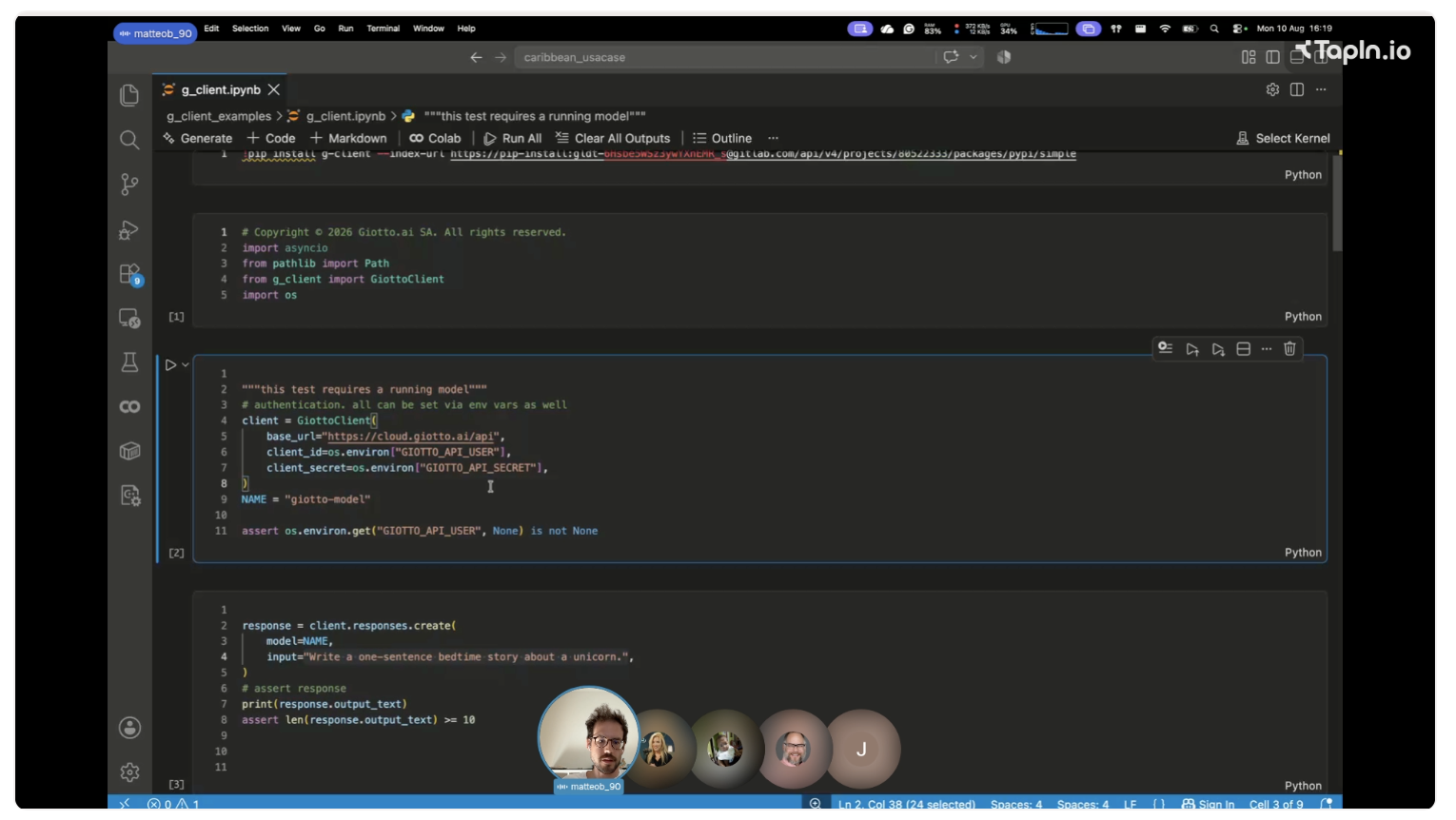
Future Caribbean recently hosted an onboarding session with the Giotto.ai team to give builders participating in the Agentic AI Buildathon a practical introduction to Giotto OS, its reasoning model, developer tools, and the access being provided to Future Caribbean participants.
Hosted by Lily Dash, the session featured Matteo, an AI researcher at Giotto.ai, alongside J. Carthy. The goal was simple: help builders understand what Giotto can do, how it can support their development workflow, and how it can be integrated into buildathon projects as a coding assistant, reasoning backend, or broader AI orchestration layer.
What is Giotto.ai?
During the session, Matteo introduced Giotto.ai as a Swiss AI company founded in 2017 by three mathematicians from EPFL in Lausanne.
The company initially worked on advanced machine-learning solutions across sectors including healthcare, insurance, banking, and defense before increasingly focusing its research on artificial general intelligence, advanced reasoning, and small-model optimization.
Matteo highlighted Giotto's performance in the ARC-AGI reasoning competitions as an example of the team's work on advanced reasoning systems.
At the center of the platform is Giotto OS, which combines a reasoning language model with an orchestration layer capable of connecting to applications and tools.
Rather than functioning only as a chatbot, Giotto can work across services such as email, calendars, Slack, documents, coding environments, and project-specific vector databases.
A reasoning model designed to run on a single GPU
One of the major technical distinctions highlighted during the session is Giotto's focus on model efficiency.
According to Matteo, Giotto's model is significantly smaller than many large flagship models and is designed to run on a single GPU. This makes local deployment possible on workstation-class hardware.
For organizations dealing with sensitive information, this creates an important deployment option: Giotto can run on hardware located inside an organization's own environment so that its data does not need to leave the office for model processing.
This can be particularly useful for industries such as legal services and other environments where sending private documents to external APIs may be undesirable.
No per-token billing
Giotto also approaches pricing differently from many traditional AI APIs.
Rather than charging users based on token consumption, Giotto normally licenses its system on a flat-rate basis. During the onboarding session, Matteo explained that once licensed, users can run the model without worrying about token-based billing or exhausting a token allocation during development.
For Future Caribbean builders, there is an additional benefit.
Free Giotto access for Future Caribbean builders
Giotto is providing free access to its API/client service for Future Caribbean participants during the buildathon.
Matteo explained that this service would normally cost approximately CHF 50 per month, but Future Caribbean builders are being provided credentials to use it for free.
He also emphasized that builders will not have a token limit under this access, allowing teams to experiment extensively while developing their projects.
There are two types of access builders should be aware of.
Giotto Cloud Chat
Giotto provides access to its hosted chat interface following registration.
Builders can use it for activities such as brainstorming project ideas, research and reasoning, working with documents and contextual information, coding assistance, and generating or refining application concepts.
During the demonstration, Matteo explained that users can register through the Giotto website, request credentials, and then access Giotto Cloud through the chat interface.
Giotto API / Python client
Builders who want to integrate Giotto directly into an application can use the Giotto Python API library.
The client can be used similarly to an OpenAI-compatible API client, making it possible to incorporate Giotto into existing AI development workflows.
How builders can use Giotto
The onboarding session demonstrated several ways Future Caribbean teams can incorporate Giotto into their projects.
Use Giotto as a coding assistant
Giotto can help generate application code, modify code, lint files, brainstorm implementations, and work alongside developers inside compatible coding environments.
During the session, Matteo demonstrated Giotto generating code from natural-language instructions and discussed using the model through VS Code.
Use Giotto as your application's reasoning backend
Builders do not have to use Giotto only during development.
The Python client allows teams to integrate Giotto directly into the products they are building.
If your application needs to analyze information, reason across multiple sources, process documents, call tools, or make decisions based on contextual data, Giotto can become the reasoning layer behind that functionality.
Matteo specifically encouraged builders to use the model as part of their solutions where advanced reasoning is required.
Connect Giotto to data and tools
Giotto OS includes an orchestration layer that can work with different applications and data sources.
The demonstration included capabilities involving Microsoft 365, email, calendars, Slack, documents and private files, project-specific vector databases, Python, web-based information, and coding tools.
This means builders can create experiences where the model does more than generate text. It can reason across context and interact with tools as part of a larger workflow.
Build multimodal applications
The API can also accept images.
During the onboarding, Matteo demonstrated Giotto reasoning over a screenshot and explained that the system supports multimodal inputs.
For buildathon teams, this opens up potential applications involving visual information alongside text and structured data.
What Giotto built during the demo
To show how builders could use Giotto in the Future Caribbean context, Matteo demonstrated two simple Caribbean-focused application ideas.
AI-powered Caribbean packing assistant
The first application generated packing recommendations for a trip to the Caribbean.
A user could provide a destination and trip duration, and the application could produce recommendations while considering information such as weather, humidity, rain, and UV conditions.
Importantly, Giotto was involved throughout the process: it helped brainstorm the idea, helped generate the code, and acted as the reasoning backend behind the application.
Caribbean activity planner
The second example was an activity planner.
A user could provide information such as destination, activity, date, time, and number of participants.
Giotto could then evaluate conditions and return guidance on whether the activity appeared suitable, whether caution might be appropriate, or whether rescheduling could be necessary.
In the demonstration, Giotto combined weather information with reasoning about conditions such as heat, humidity, UV exposure, and potential operational risks.
These applications were intentionally simple, but they demonstrated an important point for builders: Giotto can participate throughout the full development process — from ideation, to coding, to becoming part of the application's final reasoning architecture.
Start building
The Giotto onboarding session gave Future Caribbean builders more than an introduction to another AI model. It provided teams with access to a reasoning system they can use across the entire build process.
Builders can use Giotto to brainstorm concepts, write and refine code, work inside their development environment, reason across information and tools, and ultimately power features inside the application itself.
The buildathon is an opportunity to explore what happens when Giotto becomes not simply a tool you build with, but part of what you build.
Inside Future Caribbean's 12-Hour Demo Day: The Projects Presented
Across ten tracks, Caribbean innovators explored how AI could respond to real challenges — from energy and transportation to finance, climate resilience, healthcare, and the creative economy.
A Glimpse Into Future Caribbean's Demo Weekend
A weekend celebrating Caribbean innovation, AI-powered problem-solving, and the people building solutions for the region's future.