NoInfra Onboarding: Deploying Agent-Powered Applications Without the Infrastructure Headache
NoInfra founder Nikhil Tayal on one-click agent deployment, agent memory, built-in email and wallets, ~100 integrations, and $10,000 in inference credits for Future Caribbean builders.

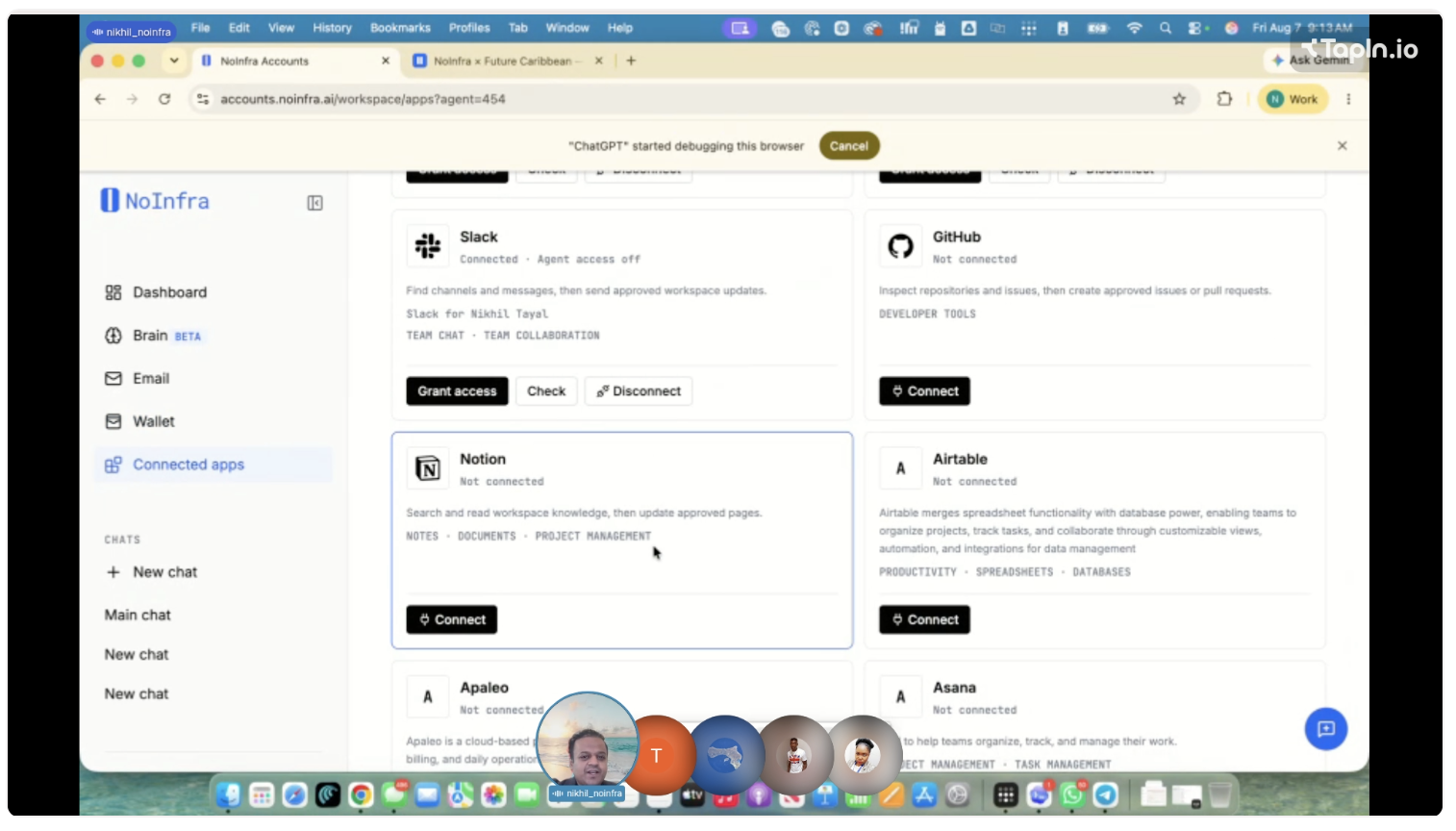
Future Caribbean hosted an onboarding session with Nikhil Tayal, founder and CEO of NoInfra, to introduce builders to a platform designed to make deploying AI agents faster, simpler, and more accessible during the Agentic AI Buildathon.
Hosted by Lily Dash, the session focused on how NoInfra can help teams move from an idea to a working agent without spending the early stages of a project configuring servers, inference systems, memory layers, mailboxes, wallets, integrations, and hosting infrastructure.
Nikhil framed NoInfra around a straightforward mission: make powerful AI agents accessible beyond highly technical teams and help more builders create practical AI applications for their own communities.
Making agent infrastructure more accessible
Nikhil opened the session by placing the current AI wave alongside previous technology shifts such as the growth of the internet and the transition to mobile computing.
His view is that AI represents an even broader shift because it affects not only software engineering but almost every function, profession, and industry.
At the same time, he argued that many of today's agent tools remain unnecessarily complex. NoInfra was created to reduce that complexity and make agent infrastructure usable by a wider range of builders.
The company's mission, as Nikhil described it, is to help democratize access to agents so that people can build useful systems without first becoming infrastructure experts.
One-click agent deployment
The core NoInfra experience is centered around deploying a working agent with very little setup.
Nikhil demonstrated how a user can log into the platform and, with a simple deployment flow, create a dedicated virtual private server with an agent already embedded inside it.
The intention is to eliminate many of the infrastructure questions builders normally face at the beginning of an agent project, such as where the agent should run and how the environment should be configured.
For Future Caribbean teams working on prototypes, this can shorten the path between deciding what an agent should do and actually testing that behavior in a deployed environment.
Built-in access to AI models
NoInfra also operates its own inference systems and provides access to open-source models directly through the platform.
During the onboarding session, Nikhil mentioned support for models including GLM, Qwen, and GPT-OSS 120B, along with different model categories for reasoning, coding, and faster tasks.
The broader idea is that builders should be able to choose an appropriate model for the task while avoiding unnecessary configuration work.
NoInfra also supports bring-your-own-key workflows, allowing builders to connect inference providers they may already be using elsewhere in the Future Caribbean ecosystem.
Working alongside Impala and other model providers
One question during the session was whether NoInfra replaces other inference providers such as Impala.
Nikhil clarified that it does not.
Instead, NoInfra can act as the agent infrastructure layer while routing inference through external providers. Builders with Impala credentials can configure their agent with the appropriate base URL and key and use Impala for inference through NoInfra.
He also discussed the possibility of integrating MiniMax keys and other providers into the platform, reinforcing NoInfra's goal of reducing the need for teams to manage multiple separate configurations themselves.
An agent needs a brain
One of the central components of the platform is what NoInfra calls the agent's brain.
This is the system responsible for memory and context.
Nikhil explained that the brain is designed to let an agent quickly retrieve relevant context across different sources without repeatedly searching through everything and consuming unnecessary tokens.
For example, a customer-support or sales agent could use that stored context to understand previous conversations, customer information, tickets, and other relevant history before deciding what to do next.
NoInfra also supports different memory scopes.
Teams can create agent-specific memory for information that should remain isolated to a particular role, alongside shared memory that multiple agents can access.
That could allow a team to deploy separate sales, marketing, customer-support, and engineering agents while controlling which information each one can see.
Built-in email for agents
NoInfra agents can also come with email functionality.
Nikhil demonstrated that every agent can have a preconfigured mailbox, allowing it to communicate with users, customers, or other systems by email.
The platform can operate with a human-in-the-loop review mode, where an email must be reviewed before sending, or with more automated settings depending on how the builder configures the agent.
Later in the session, Nikhil showed an example of an agent responding by email to a question about Caribbean weather and continuing the conversation autonomously.
For Future Caribbean teams, this could support applications involving customer service, tourism, sales, community operations, scheduling, or any other workflow where an AI agent needs to interact with people outside a chat interface.
Wallets and agentic payments
NoInfra also includes wallet functionality designed for agents that need to participate in transactions.
Nikhil described the reasoning behind this as part of a broader future in which agents may autonomously buy services, make payments, or transact on behalf of users.
The platform is working with Coinbase-based wallet infrastructure and gives users visibility into transaction history, along with configurable limits and policies to control agent spending.
He also discussed the use of the x402 protocol for agentic transactions and demonstrated controls around enabling agent spending and wallet delegation.
The important point for builders is that payments can be treated as another capability inside the agent rather than a completely separate system that must be designed from scratch.
Integrations with existing tools
Useful agents need access to the systems where work already happens.
NoInfra supports integrations across a wide range of applications, with Nikhil describing support for close to 100 tools across categories such as CRM systems, databases, Google Workspace, Google Drive, GitHub, and Slack.
Once connected, those systems can become part of the agent's working context.
That allows an agent to do more than simply answer questions. It can reason across existing data, understand previous conversations, identify what happened with a customer or partner, and determine what actions should happen next.
Agents that can build and host applications
One of the most striking demonstrations in the session was NoInfra's ability to let an agent build and deploy its own web application.
Because each deployed agent has its own VPS, the agent can create the application and host it within that same environment.
Nikhil explained that this reduces the need to separately configure another hosting provider solely for the application the agent creates.
During the demo, an agent generated a Future Caribbean and NoInfra partnership showcase, produced the application, deployed it, and made its pages interactive.
Nikhil described this as an example of where NoInfra wants the platform to go: an agent that can increasingly build and deploy complete applications from a user's instructions.
Building multi-agent applications
NoInfra's architecture also opens the door to teams of specialized agents.
A builder could create separate agents for functions such as customer support, sales, marketing, engineering, research, or operations.
Each agent can have its own memory and permissions while still sharing selected information where needed.
For Future Caribbean teams working on applications that involve several distinct workflows, this makes it possible to think beyond a single all-purpose chatbot and instead design a system of specialized digital workers.
$10,000 in inference credits for the community
A major benefit announced during the onboarding session was NoInfra's support for Future Caribbean builders through $10,000 in committed inference credits.
Nikhil clarified that these credits apply to inference compute rather than the cost of hosting the agents themselves.
Builders using the platform would still be responsible for the infrastructure or hosting cost associated with deploying their agent, but the inference layer can be supported through the credits being made available.
Nikhil summarized the arrangement clearly: teams pay for hosting, while qualifying builders can receive free inference support through the partnership.
The program also includes access to additional agent capabilities such as agentic search, email for testing and building, and the NoInfra brain, with builders primarily responsible for the hosting cost of their deployed agents.
Support for teams that want to build on NoInfra
NoInfra is not automatically distributing credits to every account.
Instead, the team wants to prioritize builders who have a clear use case and genuinely intend to build using the platform.
During the call, Future Caribbean encouraged interested teams to identify themselves so the available resources could be directed toward builders actively working with NoInfra.
Nikhil also emphasized that NoInfra is willing to work closely with teams when specific integrations or platform capabilities are needed.
The message was collaborative: if something important to a Future Caribbean project is missing, the NoInfra team is open to exploring whether it can be added quickly.
Office hours and direct builder support
Another major part of the partnership is direct access to the NoInfra team.
Nikhil committed to holding regular office hours for Future Caribbean participants, including dedicated sessions where teams can bring prototypes, explain what they are building, and receive advice on the most practical way to use NoInfra.
He discussed making time available in both morning and evening sessions, with short dedicated slots for individual teams so discussions could stay focused and actionable.
Builders were encouraged to come prepared with concrete projects and questions rather than treating the sessions as general product demonstrations.
A platform still moving fast
Nikhil was transparent that the onboarding took place while NoInfra was in the middle of a significant infrastructure migration.
As a result, some features shown during the live demo were still being moved or refined.
He said the team was aiming to have the platform ready for teams by Monday and encouraged builders to spend the weekend thinking about whether NoInfra was a strong fit for their projects.
Builders with strong alignment were encouraged to reach out directly, explain their use case, and include Lily so the NoInfra and Future Caribbean teams could prioritize the projects that intended to build on the platform.
Building agents for real communities
The NoInfra onboarding session ultimately centered on a bigger idea than infrastructure.
The goal is to reduce the technical friction between a useful agent concept and a deployed product.
With deployment, inference, memory, email, wallets, integrations, application hosting, and agent tools brought into one environment, NoInfra is attempting to give builders a more complete foundation for creating agent-powered applications.
For Future Caribbean teams, that could mean moving faster on ideas involving customer support, tourism, community services, financial coordination, research, sales, operational automation, and other real-world workflows.
Nikhil closed with a message that aligned closely with the wider mission of the buildathon: meaningful AI applications do not have to come only from Silicon Valley.
Builders anywhere can create technology for their own communities when they have the right tools, a clear problem to solve, and the willingness to experiment.
Inside Future Caribbean's 12-Hour Demo Day: The Projects Presented
Across ten tracks, Caribbean innovators explored how AI could respond to real challenges — from energy and transportation to finance, climate resilience, healthcare, and the creative economy.
A Glimpse Into Future Caribbean's Demo Weekend
A weekend celebrating Caribbean innovation, AI-powered problem-solving, and the people building solutions for the region's future.