One One Dutty Build Dam
Inside the Future Caribbean WhatsApp chat: 729 members, 4,971 messages, 86 days — and what happens when builders scattered across 39 countries find out they were never building alone.
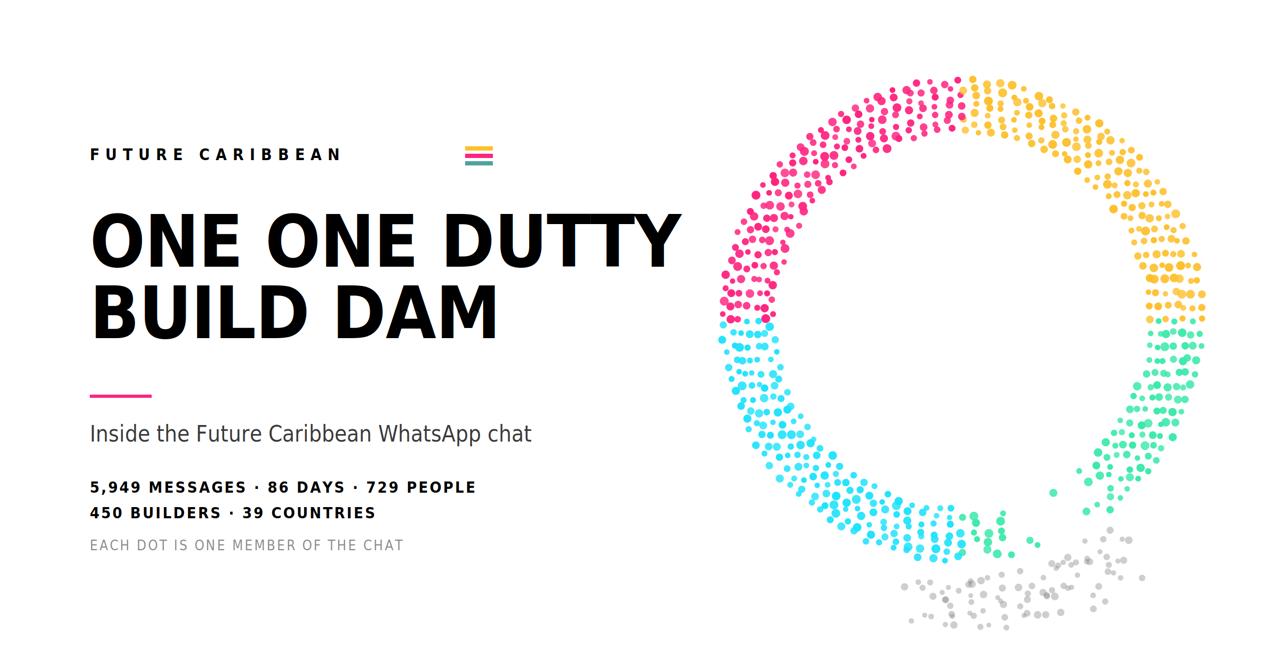
Inside the Future Caribbean WhatsApp chat
Noel is a solo engineer on Union Island, in St. Vincent and the Grenadines. His father runs the local dive shop. He missed the application window for the Caribbean's first regional AI buildathon entirely — and posted his project into the group chat anyway, unprompted, to an audience of several hundred strangers.
His reason for building at all goes back to Hurricane Beryl, and to working emergency logistics on the ground after it:
"seeing that level of devastation firsthand changed my entire perspective. It made me realize that if the Caribbean is going to truly bounce back and thrive, we can't just keep relying on outside tools. We have to build, and control our own technology."
Nobody told him to introduce himself. There was nothing to win by then. Within a few messages he has people asking about his stack.
That is the whole story of the Future Caribbean group chat in miniature. Not the New York Stock Exchange showcase. Not the prize money. Not the H200 GPUs. The thing that actually happened here is that a lot of people who had been building alone found out, at last, that they weren't.
The numbers
The group was created on May 20, 2026 — six days before Future Caribbean opened applications publicly at IDB Invest Sustainability Week in Barbados. This account is a snapshot taken on August 14 — eighty-six days in, with the chat still going.
To that point: 729 members, 4,971 messages between them, and 545 links posted.
The growth curve reads like a fever chart. The opening week averaged four messages a day. Across the last eleven days of June it averaged seventy-one. On July 6th — the day of the great platform war, of which more shortly — it hit 316 messages in a single day.
By the time the Trinidad and Tobago Guardian reported on the initiative in August, the headline figure was 450-plus builders from 39 countries in the build phase, drawn from 236 applications. Jamaica led the field with 41 applications, followed by Barbados with 33 and Trinidad and Tobago with 25, alongside submissions from the Bahamas, St Lucia, St Vincent and the Grenadines, Antigua and Barbuda, Guyana, Curaçao and the Cayman Islands. Substantial entries came from the diaspora in the US, UK and Canada — and from India, France, Nigeria, Kenya, Singapore, Ukraine and the Philippines. More than 172 advisors and judges had signed on.
And the in-chat milestones, tracked obsessively by the founder in periodic announcement posts, tell their own story:
| Date | Members | Applications | Countries |
|---|---|---|---|
| June 11 | 100 | — | — |
| June 21 | ~300 | — | — |
| June 28 | — | 44 | 21 |
| July 3 | — | 103 | — |
| July 14 | 700+ | 158 | 28 |
| Aug 14 | 729 in chat | 236 | 39 |
Forty-four applications at the end of June. Two hundred and thirty-six by mid-August, from 39 countries. If you want to know what it looks like when a region decides something all at once, it looks like that column.
"We didn't have anything 8 weeks ago"
The founder is Lily, a Barbados-based tech entrepreneur, lawyer and digital creator. She sends 641 of the group's messages — roughly one in eight of everything said. She is the chat's weather system.
Her origin story surfaces almost by accident on June 13th, when someone complains about being ghosted by a web developer. She replies:
"100% that's what happened to me with Futurecaribbean.com — I paid a dev here to take care of it for me — then he went missing, no reply 👀…. But I had a deadline so I stayed up late and did it myself on Claude, asked ChatGPT for guidance, got it out that night in time to keep my promise to our US partners 🙏 thank god, now 5000 site iterations later…. It would have taken too long with a web developer to keep up with all the back and forth. T = 0"
Three days later, an admission that reframes everything that follows:
"Events like these usually take 6+ months to organize 🫠🫠 we didn't have anything 8 weeks ago…."
That anecdote isn't a digression; it's the thesis. Her argument to the press has been that systems which once cost millions can now be designed and built in a weekend for a fraction of the price — and that this collapse in cost is what makes a regional push viable at all. She built the initiative's own website exactly that way, overnight, because she had to.
The larger premise she is selling — repeated, refined, eventually hardened into press-release cadence — is genuinely interesting, and it is not the one you'd expect. It is not Help the Islands. It is closer to the opposite.
The Caribbean, the argument goes, is one of the most operationally difficult markets on Earth: multiple countries, currencies, legal systems and languages stacked on top of shared industries and shared problems. Historically that fragmentation has been a tax. But agentic AI — systems that coordinate continuously across messy, disconnected environments — is precisely the technology whose value increases with fragmentation.
Which makes the region not a charity case but a testbed. The tagline the group adopts and repeats for three months:
"If it works here, it can work anywhere."
Forty teams on dedicated compute, then everyone. Twenty-one days. Open-source agentic frameworks. Advisors from IDB Invest and the UNDP. 50 hours of strategic consulting from EY Caribbean for selected teams, US$20,000 in AI deployment workstations from OWC, accelerator support out of Cayman, a DMZ soft-landing program, sponsored travel for founders heading to New York, and a Q3 investor showcase at the NYSE.
Lily's own summary of what had been assembled, given to the Guardian: the largest platform of technologists the Caribbean has ever assembled. Whether every piece of the schedule lands on time is, as we'll see, a live question inside the chat itself. That the pitch mobilized hundreds of builders in eleven weeks is not.
The cast
Group chats have protagonists. This one has a repertory company.
Adam (319 messages), a Jamaican engineer at a startup, is the resident pragmatist and unofficial reality-checker. He runs 70% of his workday through an agent on his phone. His contribution to the AI-and-jobs debate is the single best line in the archive: told that humans will simply find new work as machines take the old, he replies that we built the car to do the work of the horse — and "Its like telling a horse that it needs to learn how to drive." (Moments earlier he had confidently offered "mozart was deaf or something," then, "or was it beethoven." Nobody is right about everything.)
Rashad (102 messages), a Barbadian attorney, poet, farmer and self-described "village," writes long, discursive, gorgeous posts that read like dispatches from a different century. He introduces himself with a philosophy — "Do Good the Best. Do bad the Worst (by that I mean I believe in harm reduction not purity)" — and a Bajan aphorism that becomes the group's unofficial motto: "We is we." He offers free legal advice to every participant. He is also the group's most effective skeptic, in the specific sense that his skepticism makes people better.
Matthew (237 messages), in St. Lucia, is building a national health information system and quietly turning it regional. He answers other people's builds at two in the morning with questions about which triage standard they chose. He builds a gating system with human-in-the-loop review — red items stop, amber items proceed but alert him, green items run autonomously — and cites ISO 14971, NHS clinical safety standards and the EU AI Act as his reference frame, "because the Caribbean has no framework per se which covers what I am building."
Chris, Daniel, Keisha, Andrea, Talya, Craig, Shani as moderator, Britney arriving at exactly the right moment with exactly the right thing to say. Seven hundred and twenty-nine people, and maybe forty of them carry the room.
The most Caribbean argument ever had about software
On July 6th the group spends an entire day fighting about which chat app to use, and it is the single most revealing thread in the archive.
The organizers want to move structured work to Discord: threads, channels per track, voice, video, actual tooling. Reasonable. Then Melissa raises a point that reframes the entire question.
"For some populations in many parts of the world, WhatsApp can be access for 'free' or lower data costs than other platforms. Internet access is expensive and can be unaffordable when compared to overall cost of living. So forcing someone onto a platform then they have to pay for limits or makes impossible global participation…"
This is not theoretical. Another member confirms it flatly: some Digicel plans zero-rate WhatsApp. They do not zero-rate Discord. The choice of platform is, functionally, a means test.
Adam pushes back on practical grounds — you cannot participate in an online buildathon without a stable connection anyway, and Discord can be configured for low data. Keisha counters with a story about a self-taught 17-year-old programmer who learned to code by writing it out on paper.
Adam: "this was the norm in jamaica not too long ago i was made to write java and pascal on paper in highschool"
Keisha: "my point is that we are excluding unique perspectives and approaches, and resource constraints that these systems will have to function under… if it can't be done they will filter out anyway. but why exclude from the beginning"
A third builder: "The people who have access to less resources tends to be the most resourceful and always have the best ideas."
Adam: "exactly"
Then Andrea lands the point that should be tattooed inside every product team's eyelids:
"your users are not all like you. You are all aiming to strengthen systems that have not been working. On the way to creating stronger systems, you'll need people to use what you have built and follow you. They won't if they simply cannot."
A digital-inclusion seminar broke out inside a logistics decision. Nobody assigned it. The organizers eventually call for calm — "let's not argue!" — and settle on running both platforms, which is the correct and slightly unsatisfying answer most real institutions reach. But the group had already done the more valuable thing: it had proven it could disagree substantively, in public, without dissolving.
What they're actually building
Between the meta-conversations, people ship.
Noel, from the opening of this piece, is digitizing dive operations — the clipboards-and-cash economy — and building a citizen-science layer where divers report water conditions and marine life.
Theon, Trinidad and Tobago, is building safety infrastructure for medical tourism, born of a chilling observation: "Patients send $15,000 to foreign clinics based on a WhatsApp conversation and a prayer." Nine physical checkpoints, home pickup to clinic to return, functional offline.
Jamil and Jonathan, Bahamians, are building an AI launch companion for new businesses, because the information needed to legally start one in the Caribbean is scattered across dozens of ministry websites, PDFs and word of mouth. Their framing question: "What if starting a business felt as easy as talking to someone who already knew the entire process?"
Collēn, Jamaica, is modernizing rotating savings groups — susu, partner, meeting-turn — with an explicit design constraint of preserving the social tradition rather than replacing it.
Andrew, Barbados, is building energy intelligence for utilities, on the logic that for small island developing states, "energy is where our biggest vulnerability and our biggest opportunity meet."
Allan, a 30-year chartered accountant turned fintech founder, is attacking the credit-invisibility problem: solid small businesses that can't get working capital not because they're bad bets but because they can't show they're good ones.
And then, on the morning of August 13th, Matt does the thing that turns the whole chat electric. He releases model weights.
"I'm very pleased to announce that we have just publicly released one of the core parts of our project, Pulse. The part released is BimOmni and is a multimodal LLM that has been fine-tuned on Barbados context."
Public, free, on Hugging Face. He'd benchmarked it against Whisper: Whisper is faster, BimOmni is more accurate on local context — which is the entire argument for regional AI compressed into one sentence. Chris in St. Lucia immediately suggests shipping fork instructions so other dialects can be adapted. Matt's ambition for it is quietly radical:
"What would be really cool is if we could get it hosted in Barbados itself."
The thinking problem
The chat's intellectual high-water mark arrives on June 24th, when 191 messages produce something closer to a symposium than a group chat.
It starts with an observation about silos: three colonial languages, a dozen payment systems, every island rebuilding the same infrastructure in parallel. One member calls it "tower of babbled." Another notes that when a US delegation arrives at a negotiating table, twenty specialists arrive with it; no single island can staff that table, but pooled, the region could.
Then Rashad turns the whole diagnosis inside out:
"We need to do more thinking before we do. I maintain we don't have an implementation problem…. We have a thinking problem. Poorly thought and taught out ideas are implemented all the time wonderfully."
The evidence is right there, and it's local. Members dissect two recent Barbadian government apps — a bus tracker and a payment system — with the precision of people who actually tried to use them.
"pearly went to sleep at 11 pm so I missed the bus by 3 mins but the 12 one came. I don't think the app was designed by a person who catches [the bus] in Barbados."
"bimpay… we had an existing system that worked. Then all of a sudden I couldn't transfer money to my cousin who was having an asthma attack after the polyclinic was closed."
Nobody is dunking. Everyone in that exchange wants those apps to work; several of them know the teams. But the critique is exact, and it explains why a group like this needed to exist: not a talent shortage, a proximity shortage. The distance between the person specifying the system and the person standing at the bus stop.
Rashad also names the quieter structural problem — that when decisions get made in the rum shop or on the golf course, "the woman who is not a part of the boys club… doesn't even know there is an opportunity."
The founder's own framing of the capacity problem, posted four days later, is one of the sharpest things in the archive:
"Too many of our systems are only partially on. If you have to wait for a service, then for you, in that moment, the system isn't really on."
And, quoting a line she keeps returning to:
"There are decades where nothing happens, and there are weeks where decades happen."
The reckoning
Then reality arrives, on schedule, the way it always does.
Late July: hundreds of applications and a judging process that slips. The compute rollout slips. Welcome emails go out in waves. On July 31st the founder posts what is, by the standards of most organizations, an unusually clean admission:
"Thank you guys, we are pushing to the max. My sincere apologies for the delay. I overshot the timelines and that's on me."
And two weeks earlier, the line that most accurately describes the entire enterprise:
"We're building the plane while flying it."
On August 1st, a builder posts a DNS error — NXDOMAIN on the compute gateway subdomain, checked from two separate networks — and three other developers confirm it independently. The infrastructure genuinely isn't there yet. What follows is the chat's second great argument, and it matters more than the first.
One camp says: be patient, be grateful, build with what you have. It is heartfelt and it is not wrong. "Good things always comes to those who wait."
Matt, who has run and competed in hackathons globally for years, says something harder:
"one of the fastest ways to disillusion developers is to have them building towards unclear goals/timeline/prizes. I am building my project regardless, and I am lucky to have the privilege that I can take that view…"
And when told the prize money shouldn't be the motivation:
"Respectfully, you are missing the point. The prizes and resources may not be a motivating factor to you or to I, but if the goal here is to cast the widest net and encourage a true diversity of developers, then we need to be cognisant of their needs and expectations, and to say 'lets forget about the money' is a very privileged view that not everyone can afford to take."
This is the group at its best: a person who wants the event to succeed, saying the uncomfortable thing because he wants it to succeed. Note that it's the same fault line as the Discord argument — who can afford to participate on these terms — surfacing in a completely different context. The chat found its recurring theme without ever naming it.
Britney arrives with the veteran's shrug ("stuff like this happens all the time… most developers were building without wifi, for hours"). Adam offers the etymological defense: "its in the name hackathon you have to hack something together." David offers the most durable reframe in the thread — that the sponsors and compute were never the real asset:
"There are many of us looking for developers, myself included, and we still end up searching in Latin America, the USA and Europe, while the talent exists right here in the Caribbean. That is not a talent problem, it is a visibility and coordination problem, and it is one we can fix ourselves starting in this group."
The resolution, when it comes, is better than the original plan. Instead of 40 funded teams, the organizers scramble additional partners — six infrastructure providers where there had been one — and open resources to every team that applied. Forty keep the dedicated H200 allocation; everyone else gets cloud credits, API access, model accounts, and a 21-day window starting from whenever their tools actually land. Four hundred and fifty builders, not forty.
What it was for
Read the whole archive end to end and a pattern emerges that nobody in it seems to have planned.
The prize money is real. The NYSE stage is real. But almost none of the group's best moments are about either. The best moments are two people discovering they've been solving the same problem in different countries. Somebody posting a broken prototype at midnight and getting four useful replies before 1 AM. A lawyer offering pro bono work to strangers. An engineer open-sourcing a model he could have kept.
Chris in St. Lucia says it plainly on the last day of this snapshot:
"the competition is just a small bonus — the value is the kind of talent that has been attracted across the diaspora and is positively collaborating to solve real problems."
Or, from a fintech builder on August 1st, in a line that is both a joke and a thesis and — given that you are reading this — a prophecy:
"Need to build an agent that can grab all messages in this chat to analyse them."
The founder's favorite proverb, dropped into a thread about idea meritocracies and multisignature systems, is Guyanese and roughly four hundred years older than any of the technology being discussed:
"One one dutty build dam, cross the Ganges."
One clod of dirt at a time, the dam gets built. Eighty-six days, 4,971 messages, 729 people in the room, 450 builders across 39 countries. It is not a finished dam, and nobody is pretending otherwise — several of the builders will tell you so, at length, with receipts. The chat did not stop when this snapshot was taken. It is still going as you read this.
But somewhere on Union Island, an engineer who never made it onto a team, who had no compute allocated and nothing left to win, is still writing software for his father's dive shop and for the reefs around it — and he is no longer doing it alone.
That's a clod of dirt. That's how it starts.
Compiled from a snapshot of the Future Caribbean WhatsApp chat, May 20 – August 14, 2026, with additional reporting from the Trinidad and Tobago Guardian. The chat is ongoing; all figures are current to August 14. Messages lightly trimmed for length; spelling and punctuation preserved as sent. Participants identified by first name or handle only.
Inside Future Caribbean's 12-Hour Demo Day: The Projects Presented
Across ten tracks, Caribbean innovators explored how AI could respond to real challenges — from energy and transportation to finance, climate resilience, healthcare, and the creative economy.
A Glimpse Into Future Caribbean's Demo Weekend
A weekend celebrating Caribbean innovation, AI-powered problem-solving, and the people building solutions for the region's future.