Rewriting the Caribbean Financial Operating System with Agentic AI
Builders from WAM, Naytive, Kori, Smarter Partner and Activate.io on fragmented financial infrastructure, stablecoins as practical rails, cross-border investing, community savings, and agentic AI as the coordination layer.
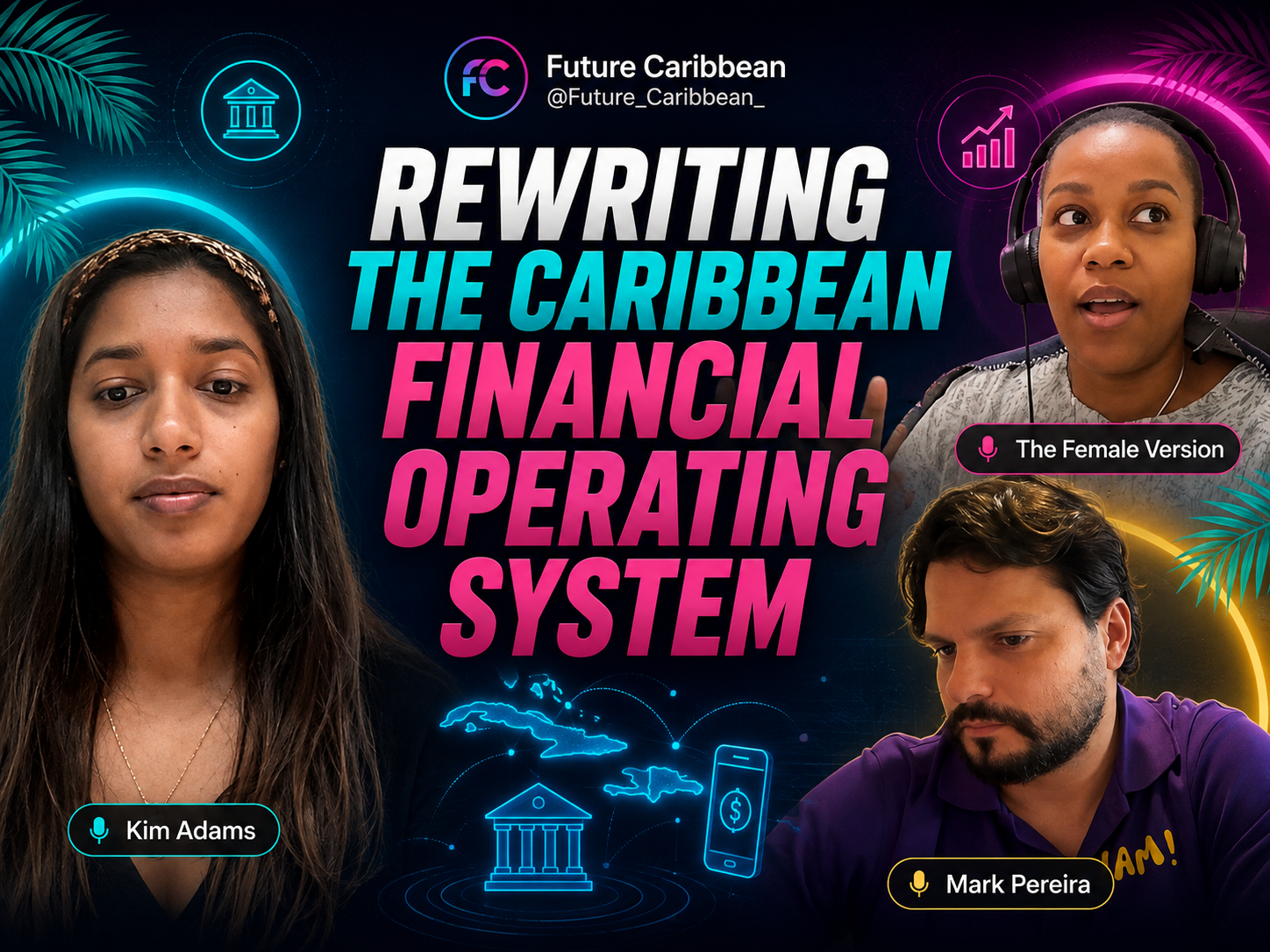
Future Caribbean hosted an Agentic AI for Finance Brainstorming Session, bringing together builders and industry voices to explore how the region could modernize payments, business formation, investing, compliance, and financial intelligence.
Hosted by Lily Dash, the session featured Mark Pereira, Kim Adams, Fadjiah Collin, Jaden, and other Future Caribbean builders working across fintech and financial infrastructure.
Finance was one of the strongest tracks in the buildathon, and Lily emphasized that financial infrastructure also sits underneath almost every other sector — from tourism and real estate to disaster management and the blue economy.
The core problem: fragmented financial infrastructure
A major theme throughout the session was the difficulty of moving money and doing business across Caribbean markets. Different currencies, regulators, banking systems, settlement networks, and legal frameworks create significant friction for founders and businesses.
Mark Pereira described how traditional banks can become gatekeepers to fintech innovation, because newer companies often need access to legacy banking infrastructure that is expensive and difficult to integrate with.
This fragmentation makes cross-border business slower and more expensive, and reduces the ability of Caribbean startups to scale regionally.
WAM: building faster regional settlement
Mark presented WAM as an attempt to connect traditional financial systems with newer digital rails. The platform uses stablecoins, payment tools, and local financial infrastructure to make it easier for users to access foreign currencies and transact digitally.
The longer-term goal is a more fluid settlement layer across Caribbean currencies, without requiring every transaction to move through traditional international banking routes. WAM has also been using AI to build adapters on top of legacy banking systems so transactions can be reconciled closer to real time.
Stablecoins as practical infrastructure
Stablecoins were discussed less as speculative assets and more as practical financial infrastructure. Mark described Caribbean businesses using them to access foreign suppliers, and individuals using them to fund payment cards where traditional access to foreign exchange is limited.
For builders, the key opportunity is using blockchain rails where they genuinely reduce cost and friction, while still operating within real regulatory systems.
Naytive: a smart account for global builders
Kim Adams introduced Naytive, a smart-account platform designed to simplify the administrative burden of running a company. Naytive brings together company formation, banking access, compliance, filings, and other business infrastructure in one place.
The platform also uses persistent data and AI to monitor regulatory changes, government programs, tax incentives, grants, and visa opportunities that may be relevant to a founder or company. Kim demonstrated how the platform can reuse existing KYC information, coordinate with financial providers, and reduce the number of separate systems founders need to manage.
WAM + Naytive: why collaboration matters
One of the strongest moments in the session was recognizing the natural overlap between the builders. Naytive can simplify company setup and administration. WAM can provide access to payments and local financial rails.
Instead of each company rebuilding the other's infrastructure, the teams can connect their capabilities. Lily emphasized this kind of cross-pollination as one of the main purposes of the Future Caribbean buildathon.
Kori and cross-border angel investing
Fadjiah Collin introduced Kori, a platform focused on helping angel investors invest across borders and support the due-diligence process.
Her biggest challenge was not necessarily the technology. It was the law.
Digital platforms can move across borders easily, but investment regulations remain jurisdiction-specific. Fadjiah explained that deciding where to launch Kori is therefore heavily influenced by the legal framework available in each market — highlighting one of the biggest regional opportunities: using AI and better infrastructure to help founders navigate fragmented legal and regulatory systems.
Smarter Partner: digitizing community savings
Another builder presented Smarter Partner, a digital version of the traditional rotating savings systems used across Caribbean communities. The goal is to make these informal structures easier to manage while improving transparency for organizers and members.
The idea stood out because it does not import a foreign financial model. It modernizes a financial system that already exists within Caribbean communities.
Building "settler infrastructure"
Lily introduced the concept of creating settler infrastructure rather than infrastructure designed primarily for extraction — systems that help the Caribbean retain, circulate, and compound wealth locally rather than allowing value to continuously leave the region.
That could include:
- better local investment products;
- cross-border payments;
- regional settlement infrastructure;
- digital business formation;
- community-based savings tools;
- tokenized assets;
- smarter regulatory coordination.
The discussion positioned this as one of the most important long-term opportunities for the region.
Jaden and financial intelligence
Jaden demonstrated Activate.io, a platform designed to turn fragmented information into evidence-backed analysis for Caribbean decision-making. The system combines multiple sources, uploaded documents, confidence scoring, and AI workflows to generate structured recommendations.
During the demo, Jaden showed how the platform could evaluate information related to Caribbean energy and infrastructure projects and produce decision-support outputs with traceable sources. That adds another essential layer to financial infrastructure: better decisions require better data.
Agentic AI as the coordination layer
The clearest theme across the session was that agentic AI can help coordinate systems that are currently fragmented. AI can help:
- reconcile transactions across legacy banking systems;
- monitor compliance and regulatory changes;
- identify grants, tax credits, and business opportunities;
- support cross-border due diligence;
- organize financial data;
- connect different financial and legal systems.
In the Caribbean, where fragmentation is one of the biggest barriers to scale, coordination itself becomes infrastructure.
Rewriting the financial operating system
The session was not really about building one fintech company. It was about building the pieces of a new financial operating system.
WAM is working on settlement and payments. Naytive is simplifying company formation, compliance, and financial administration. Kori is tackling cross-border investing. Smarter Partner is modernizing community savings. Activate.io is building financial and strategic intelligence.
The opportunity is in how these systems can work together. The next generation of Caribbean financial infrastructure will likely be built through interoperability, collaboration, AI-driven coordination, and regional thinking rather than through another isolated financial product.
Inside Future Caribbean's 12-Hour Demo Day: The Projects Presented
Across ten tracks, Caribbean innovators explored how AI could respond to real challenges — from energy and transportation to finance, climate resilience, healthcare, and the creative economy.
A Glimpse Into Future Caribbean's Demo Weekend
A weekend celebrating Caribbean innovation, AI-powered problem-solving, and the people building solutions for the region's future.