The Open Track: Where Builders Are Reimagining What AI Can Do
Inside Future Caribbean's Agentic AI Open Track brainstorming call with IDB Invest's Christopher Burt and Exodus Capital's Chjango Unchained — employment, healthcare, travel, physical AI and the capital needed to scale.

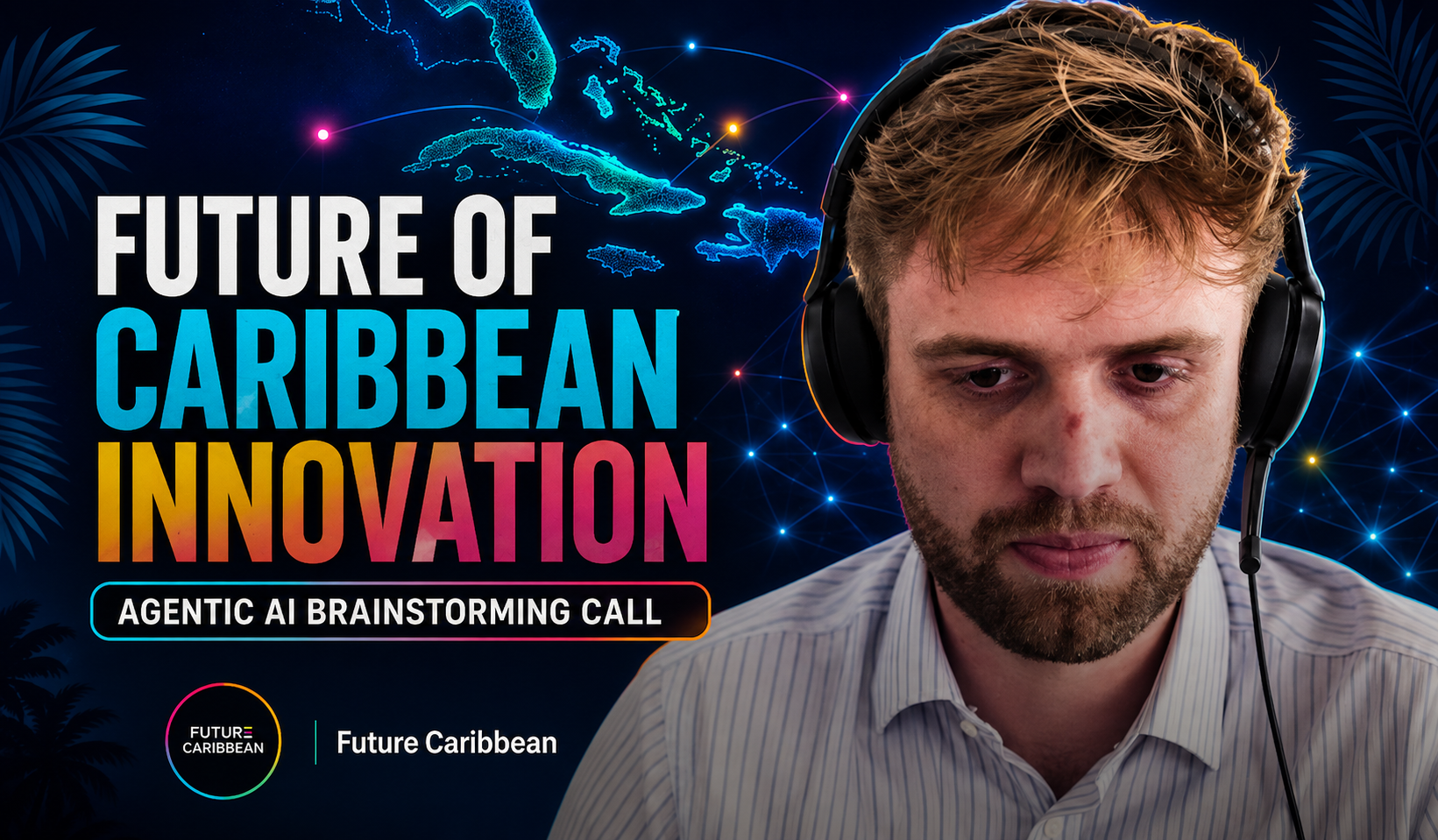
Inside Future Caribbean's Agentic AI Open Track brainstorming call with IDB Invest's Christopher Burt and Exodus Capital's Chjango Unchained.
What happens when you bring regional builders, development finance, venture capital and frontier technology into the same conversation?
You start to see a different picture of the Caribbean.
Not simply a region waiting to catch up technologically, but a collection of markets with highly specific problems that may make them particularly well suited to a new generation of AI-native solutions.
That was the central question explored during Future Caribbean's Agentic AI Open Track Brainstorming Call, bringing together builders from across the ecosystem with Christopher Burt of IDB Invest and Chjango Unchained of Exodus Capital.
The conversation moved from AI-powered employment and healthcare to travel, regional integration, infrastructure, physical AI and, perhaps most importantly, the financing required to turn promising ideas into durable companies.
Building for the realities of the Caribbean
The Open Track is deliberately broad. Rather than asking builders to solve one predetermined problem, Future Caribbean is creating space for them to identify where agentic AI can have the greatest practical impact.
One of the first demonstrations illustrated exactly why that approach matters.
A builder showcased an AI-powered employment platform designed to help people discover and apply for jobs through familiar channels such as WhatsApp. The system can analyse a CV, identify skills gaps, recommend relevant roles, generate tailored CVs and cover letters, prepare candidates for interviews and ultimately automate parts of the application process.
The regional opportunity is straightforward: many people across the Caribbean may not interact with technology primarily through a desktop computer. A WhatsApp-native experience can therefore become a much more accessible interface for accessing global employment opportunities.
The platform is also designed around a larger idea: using AI to bridge the gap between what employers need and what workers currently have.
This is the kind of problem where agentic AI becomes more than a chatbot. Instead of simply answering a question, an agent can take a user from intent → analysis → recommendation → preparation → action.
Healthcare: AI with humans firmly in control
Another builder, registered nurse Esther, demonstrated CareBridge Continuum, an AI-assisted healthcare coordination platform designed to close the gaps between home, hospital, pharmacy and follow-up care.
The demonstration centred on a synthetic patient in Barbados living with diabetes and high blood pressure. Rather than attempting to replace healthcare professionals, CareBridge uses AI to coordinate information, surface inconsistencies, support workflows and maintain accountability while keeping licensed professionals responsible for clinical decisions.
The system demonstrated everything from medication safety and identity verification to referrals, discharge planning and post-hospital follow-up.
Its architecture is particularly relevant to Caribbean realities. CareBridge is designed to continue functioning during connectivity interruptions, with information able to be stored securely and synchronised when service returns. It also envisions care coordination across national borders, allowing a patient in one Caribbean country to connect with specialist services elsewhere while maintaining explicit consent, data boundaries and professional responsibility.
The underlying principle is powerful:
AI can coordinate the complexity without taking control away from the people responsible for the outcome.
From fragmented services to an AI-native Caribbean
Later in the call, Nas demonstrated Barrow, an AI-native commerce platform designed around another familiar Caribbean challenge: fragmentation.
For residents, visitors and members of the diaspora, organising even a relatively simple trip can require jumping between accommodation websites, car rental companies, tour operators, event listings, WhatsApp conversations and social media pages.
Barrow's AI concierge takes a different approach.
Instead of requiring a user to search through individual categories, the user can simply state an outcome — for example, "Plan my trip to Barbados."
The agent can then organise the request into a journey involving accommodation, transportation, activities and other services, while allowing the user to review and approve decisions along the way.
Importantly, the platform deliberately keeps the human in control of transactions. The AI can coordinate the journey, but the user remains responsible for approving purchases.
This reflects an important distinction in agentic AI: autonomy does not have to mean removing human agency.
The investment question
But building the technology is only one part of the challenge.
The more fundamental question raised during the call was: how does the Caribbean finance and scale the companies capable of transforming these markets?
Christopher Burt, Corporate Governance Senior Officer at IDB Invest, brought a development-finance perspective grounded in years of working across Latin America and the Caribbean.
IDB Invest operates across 25 countries in the region and has investments across eight Caribbean member countries, spanning financial institutions, corporations, infrastructure and investment funds.
Burt highlighted a paradox.
There is significant innovation happening across the region, but entrepreneurs can struggle to access the external financing required to scale. At the same time, investors can hesitate because Caribbean markets are dispersed across different jurisdictions, currencies and regulatory environments.
In other words, the opportunity exists, but the pathways connecting capital to opportunity are often fragmented.
Regional integration could be an AI opportunity
One of the most interesting threads of the conversation was the relationship between AI and regional integration.
Burt described a significant lack of integration across Caribbean markets, while noting that larger corporate and financial players are already attempting to operate across jurisdictions and leverage regional scale. He pointed to markets including Guyana, Suriname, Trinidad and Barbados as examples of different opportunities emerging across the region.
This is where agentic AI becomes particularly interesting.
The Caribbean does not necessarily need to reproduce the infrastructure of a single large continental market in order to become more connected.
Digital agents can potentially help reduce some of the friction created by borders, fragmented information, different service providers and disconnected systems.
The opportunity is not simply to build another app for each island.
It is to build digital infrastructure that allows those islands to interact more intelligently.
As Burt put it, AI creates an opportunity to reduce some of the physical friction involved in connecting people and markets, while creating wider integration across the region.
What physical AI can teach us
Chjango Unchained, founding general partner of Exodus Capital, brought a different perspective to the discussion.
Exodus is focused on early-stage robotics and physical AI. Chjango described the fund's thesis around hardware as a "foot in the door": hardware can establish a relationship with a customer, but the longer-term opportunity can come from software becoming integrated into the customer's workflows.
Although Chjango noted that his own direct experience in the Caribbean is limited, he highlighted the broader expansion of robotics and physical AI into emerging markets, including South America.
The implications for the Caribbean are worth considering.
Physical AI could eventually touch agriculture, logistics, energy, ports, manufacturing and other sectors where the region faces labour and infrastructure constraints.
But the Open Track conversation also demonstrated that the opportunity does not begin and end with robotics.
The Caribbean may have an opportunity to combine agentic software, physical infrastructure and regional networks in ways that address problems unique to smaller, distributed markets.
Financing the companies that emerge
Burt's perspective brought the conversation back to one of the biggest constraints facing regional innovation: capital.
IDB Invest uses an approach known as "Originate to Share," in which it can originate and structure transactions and bring in external third-party funding to mobilise additional capital into the region. Burt described this as a model the institution wants to scale.
The challenge is not necessarily a lack of investor appetite.
It is often the infrastructure around that appetite: appropriate investment vehicles, confidence in unfamiliar markets, governance standards and mechanisms that can efficiently move capital toward entrepreneurs.
For early-stage companies, this matters enormously.
A strong prototype is not enough.
Companies need customers, distribution, governance, financing and the ability to operate within the regulatory and institutional realities of their markets.
Build with customers, not just for them
This became one of the clearest messages of the session.
Future Caribbean's Lily Dash challenged builders to move beyond simply building technology and hoping that users eventually arrive.
The real intelligence comes from customers.
Their feedback reveals which features matter. Their behaviour reveals what they will actually use. Their problems create the product's differentiation.
And ultimately, distribution and customer relationships can become a stronger moat than the technology itself.
That lesson was visible throughout the demos.
The employment platform is adapting AI to how Caribbean users already communicate.
CareBridge is adapting healthcare coordination to realities such as WhatsApp access and unreliable connectivity.
Barrow is attempting to turn a fragmented collection of local businesses and services into a connected digital layer.
These aren't generic AI products with the word "Caribbean" added to the pitch.
They are attempts to build from the region's actual constraints and behaviours.
The Caribbean as a testbed for what comes next
Perhaps the most compelling conclusion from the conversation is that the Caribbean's fragmentation should not only be viewed as a disadvantage.
It could also become a design constraint that forces builders to create better systems.
Multiple jurisdictions. Multiple currencies. Small and distributed markets. Limited infrastructure. Connectivity challenges. Diaspora networks. Highly specific local contexts.
These conditions create problems.
But they also create opportunities for technologies capable of coordinating complexity.
Agentic AI is fundamentally about turning intent into action across multiple steps, systems and sources of information.
That makes it particularly relevant to markets where the biggest problems are often not a lack of individual services, but the difficulty of connecting those services together.
Inside Future Caribbean's 12-Hour Demo Day: The Projects Presented
Across ten tracks, Caribbean innovators explored how AI could respond to real challenges — from energy and transportation to finance, climate resilience, healthcare, and the creative economy.
A Glimpse Into Future Caribbean's Demo Weekend
A weekend celebrating Caribbean innovation, AI-powered problem-solving, and the people building solutions for the region's future.