Future Caribbean: A Global Platform for Regional Growth
Founder Lily Dash recounts a conversation with Dr. Ralph Chami — former IMF mission chief — that confirmed the Caribbean is sitting on billions in natural assets it has never monetized, and why the region's future comes down to a single word.
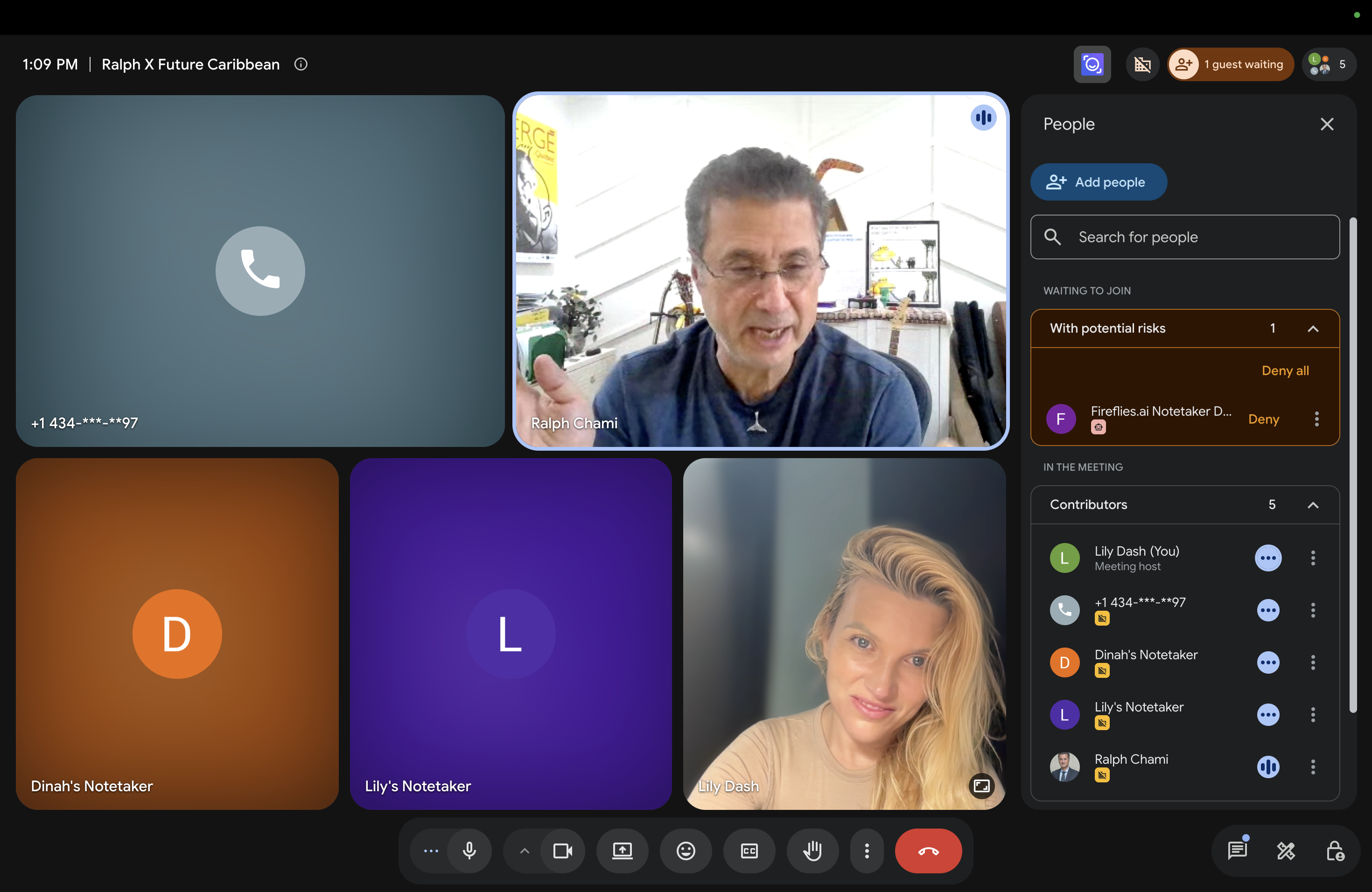
This afternoon I had the most important conversation I've had since beginning this work. A mutual friend connected me with Dr. Ralph Chami — an economist who spent 25 years at the IMF as mission chief and division chief, wrote the definitive book on macroeconomic policy in fragile states, spent three decades building financial markets for countries, and is now pioneering an entirely new way of valuing the natural world.
I went in to explain what we're building. What I found was someone who had already lived, from the other side of the table, every problem I described — and who saw immediately why the answer we've arrived at is the right one.
By the end of the call we had covered: a Caribbean nation sitting on as much as $90 billion it didn't know it had; a "swamp" a government wanted to dredge that turned out to be worth $265 million a year; how Tesla actually makes its money; an electric grid that could pay for itself; a coming change in international accounting rules that will rewrite national balance sheets by 2028; and why the entire region's future comes down to a single word. It's all below.
What I told him
I laid out the Caribbean as I see it: one of the world's great opportunity regions, with extraordinary talent, vast ocean resources, and strategic geographic advantages. As the world becomes increasingly connected, the region has an unprecedented opportunity to unlock even greater value through deeper collaboration across islands, institutions, and industries. After years of working with global investors, philanthropies, governments, and technology leaders, one thing became clear: the Caribbean needed a platform through which the world could engage the region at scale. That's where Future Caribbean comes in—not as another initiative, but as a global platform and regional growth engine that brings together governments, development banks, global technology companies, investors, founders, universities, and philanthropies to accelerate the development and deployment of Agentic AI solutions across the blue economy, finance, healthcare, food systems, energy, and climate resilience. By connecting world-class expertise, technology, capital, and Caribbean leadership, Future Caribbean is creating new pathways for innovation, investment, and long-term economic growth across the region.
What Ralph told me
Ralph's response was that we intersect completely, because everything he does is about regenerative GDP — and the Caribbean's problem is precisely the one I described: fragmentation.
He started with the flaw at the center of the current system. A question a famous oceanographer once put to him: what is the value of a fish swimming freely in the ocean? Under our current economics, the answer is zero. The fish only acquires a price — thirty dollars — once she's taken out of the water, suffocated, fried, and put on a plate. A tree has no value until it's cut down and becomes timber. Anything you kill or extract has a price; what keeps you alive is priced at exactly zero. That is why nature is dying with impunity — and it is the flaw his work exists to correct. His answer: the living seagrass, the salt marsh, the mangroves have value alive and well — and that value can be monetized. Think of owning an apartment: it's your asset, but if you never rent it out, your income never changes.
And this is not an island-only conversation. He has done this work for the Philippines with the Asian Development Bank, and is running projects in the Azores and starting in Sardinia — even developed countries are now asking the same question: what do I have in nature?
Sitting on billions and not knowing it
When I raised the news that Guyana had just sold $400 million in carbon credits from its forests, he confirmed that this is the new system taking hold — and that it's happening everywhere. He told me about advising one small island nation in the Caribbean sitting on the largest seagrass meadow in the world — a meadow that once spanned 150,000 square kilometers and has been degraded to around 95,000 by anchors dragged across the seabed, burn pits, and sewage in the water. Simply protecting what remains could be worth around $12 billion. Restoring it to what it once was: potentially $80–90 billion, for a country whose entire GDP is $18 billion. That would make it the richest country per capita on the planet. When he presented this to the country's leadership, they asked him if it was magic. His answer: "It's not magic. It's magical. It's one plus one equals two. It's pure finance."
And it's already moving. Right now, in those waters, a company has invested $30 million to build the scientific baseline for that seagrass — because it's the delta against the baseline that gets monetized. The country's relationship with its nature is changing in real time: protect and restore, and it pays in perpetuity — not only in carbon, but in enhanced fish stocks, which means food security, which means resilience that stabilizes people on their land.
The market logic is straightforward. The world needs nature to fight climate change — that's the demand side. Island states are sitting on the supply side. He compared it to the Gulf states, who sat on "black goo" for a thousand years without knowing what to do with it — until the automobile created demand for oil, and suddenly there was a market and a price. Agree on a price, and you're off to the markets. I raised the Gulf model myself — they monetized what they had. He agreed, with one addition: the Caribbean is in a better position than the Gulf ever was, because our nature is still largely intact and far more beautiful — we're just not making the most of it. And the way to make the most of it is not to sell it or destroy it, but to bring investment into its protection and restoration. That's the new paradigm.
The grid that pays for itself
Then he told me something that applies directly to my own island. He'd once been approached by an innovator from Barbados who wanted to replace the island's diesel grid with a battery-powered one. Ralph's answer: the moment you replace diesel, you avoid emitting carbon dioxide — and that avoided carbon can be calculated and sold as avoidance credits. Because it's technology, the calculation is clean and linear, which is exactly what buyers want. The credits could pay for the grid. With the right diplomacy, other nations would fund it — and Barbados wouldn't pay a penny.
Consider Tesla. People think Tesla makes money selling cars. Strip out the carbon avoidance credits and Tesla would have posted losses. The avoidance itself is the product. There is a whole class of green technology companies whose credits — from both avoiding and absorbing carbon — can be calculated and monetized the same way. This is a revenue model sitting in plain sight for every island still burning diesel.
"How dare you call it a swamp"
One story from the call illustrates the entire shift. At a caucus meeting on an island, a senior official announced plans to dredge "the swamps" to build hotels.
He asked the official to define a swamp. The answer: mangroves.
"That's an insult to the mangroves," he told them. "If I were a mangrove tree, I'd be hurt. I suck carbon out of the atmosphere for you. I create more fish for you. I protect your island from flooding — I'm what keeps your expensive villas worth anything. And you call me a swamp?"
Then he did the math. Those mangroves were providing roughly $265 million a year in carbon value alone — before counting the fish stocks and the flood protection. The plan on the table was to trade that for one hotel that would pollute everything around it and kill the goose that lays the golden egg.
The dredging push came from a powerful developer on the island. Ralph's response wasn't to fight him — it was to ask to speak with him. A smart businessman wants to make money; the case to make is that he earns more by leaving the critical areas intact and monetizing them than by building one polluting hotel. Not every area can be left alone — the extractive and the regenerative can exist side by side. But you have to have the vision to know which is which.
This is the shift in one sentence: nature moves from being a cost proposition to being an investable asset. Not "how much does conservation cost?" but "how much is this asset paying me, and how much more will it pay if I invest in it?"
Nature is infrastructure — and for islands, it's existential
It isn't theoretical. He described visiting islands after a catastrophic hurricane: where the mangroves and seagrass were intact, there was no evidence a hurricane had passed. Where they'd been removed, the waves came all the way inland, destroyed everything in their path, and pulled people back into the sea. That one hurricane put an entire island nation into debt worth 85% of its GDP.
He was blunt about what this means for us. Mainland countries have somewhere to retreat to — flooding on the coast, safety inland. Most Caribbean islands don't have that option. The loss of nature and climate risk are, for us, existential — we are one foot away from oblivion. Which makes the choice sharper: dig for more oil and gas, and you destroy the very nature that keeps the waves off your shore.
So nature is not just carbon sequestration. It is flood avoidance, food security, employment, poverty alleviation, and the resilience that keeps people stable on their land. He prefers the word infrastructure: nature is the infrastructure of everything. A win-win — nature wins, people win, and future generations inherit wealth built by growing nature rather than destroying it.
And the world is beginning to codify it. A new regulation — IPSAS 51, the International Public Sector Accounting Standard — becomes the law of the land by January 2028: if a country is actively conserving its nature, that nature enters the public sector's balance sheet as an asset. Kenya, Australia, New Zealand, and Canada are among the early signatories. The Caribbean, rich in exactly these assets, should be first in line.
One voice. One metric. One price.
Everything I've encountered trying to build in the Caribbean, he'd seen from inside the institutions.
He confirmed the negotiating reality: small island states, alone, get picked off one by one. Big buyers come in and pressure a single island to sell its carbon for $2, then turn around and sell it for $100 — he knows because he works with the demand side and watches them insist on negotiating with each island separately, precisely to force the price down. Years ago he was asked to design a nature bank for the Caribbean around a simple principle: the islands are too small to negotiate alone, but together they're formidable. One entity advocating on behalf of all the islands, negotiating the $100 price, with a sharing rule among them. One voice. One metric. One price. The oil-producing nations don't even like each other — some have gone to war — but on the price of oil they act as one, because it benefits all of them. The Caribbean can do the same.
He made the same point about capital markets, from 30 years of building financial markets for countries: a tiny island doesn't need its own stock exchange with three listings and no liquidity — it needs access to an exchange where its best firms can be seen by the world and bring capital in. The goal was never ownership of the plumbing. The goal is access to the market.
Then he connected it directly to our work: our agentic AI platform is that mechanism. It's not only about speed — though it compresses time dramatically. It forces the islands onto one language, one metric, one standard — because without a shared metric you cannot compare, and without comparison there is no market, just as real estate cannot be valued without a common yardstick. It lets governments finally see, on net, what's actually happening in their own countries — which matters even for their national climate commitments, the NDCs every country reports against — because today the data is siloed, a black box, and one project might be sequestering carbon while another project on another island works directly against it, with nobody able to see it. It turns a scatter of fragmented projects into a portfolio, and the value of a portfolio is greater than the sum of its parts. A one-stop shop for the region. And as everyone joins the platform, they start to see each other on it — it becomes the club, the meeting place, the signal.
He also told me what my job will actually be: education. For many of these countries, the deepest deficit isn't money — it's information. They don't know what they don't know, and therefore they can't make good choices. The approach is never to force: Are you aware of this? Did you know? Now make your own decisions.
I put it to him this way: though we are many, we can move as one — the outcome is oneness without anyone losing their identity. He agreed exactly: you're still Saint Lucia, still Barbados, still the Bahamas — but where it matters, vis-a-vis the world, you're one.
He also named the confidence problem directly. The hardest question you get on the ground is "who else is coming in?" — and a neighboring small island is not a convincing answer. It has honestly been easier for me to bring in the New York Stock Exchange than to align the people at home. He wasn't surprised. The big names have confidence; the region, because of its history, is still building its own. Which is exactly why the platform has to carry the big names — they give everyone else the assurance to step in.
The tribe finding its way home
Ralph made a final point. None of this is new. Indigenous peoples never lost their relationship with nature — never stopped understanding that we live with it, not at its expense. We're not inventing anything. We're the tribe that got lost and is finding its way home. The technology accelerates that return. The future doesn't belong to us — it belongs to the generations who inherit our decisions, and we have no right to rope them into something they didn't sign up for.
What we are building is a new operating system for the Caribbean — built on collaboration, powered by technology. Nature is not one piece of it — nature is everything. We are nature. The seagrass and the mangroves, the fisheries and the coastlines are the same story as the economy: a region growing at 1% while inflation runs at 4%, administrative costs consuming a third of GDP on every island, markets so small and so distributed that capital, liquidity, and talent all flow elsewhere. These are not separate problems. They are one problem — the word the whole region's future comes down to is fragmentation — and they share one answer. An operating system that unsilos the data, unifies the language and the metrics, and connects the builders, the governments, the capital, and the communities on one platform. One that gives the region what it has never had: direct access to global markets, and the ability to negotiate as one. Because that is where the leverage lies. Jamaica's national motto has already said it best: Out of Many, One People. It is time to make it true for the whole region — of many islands, one voice. Each island keeps its identity; together, vis-a-vis the world, we are formidable.
This conversation confirmed that every piece is now in place — the demand exists, the assets exist, the accounting standards are coming, and the technology to unify it all has arrived. What remains is the work of collaboration, and that work has begun.
Now we build. Together.
From Carnival to Claude: The Caribbean’s Next Wave of Builders
Justin Elliott joined Future Caribbean to talk about Agentic AI. His most compelling message was about knowing a problem well enough to build something people need.
Patch Tuesday, Exploit Wednesday: How AI Just Closed the Gap Between a Hack and a Fix
Sigma Prime co-founder Mehdi Zerouali tells Caribbean builders the real risk of vibe-coded software is not bad code — it is what nobody thought to ask an AI to protect.